
Japan Art and Buddhism: Perpetual Travelers
Lee Jay Walker
Modern Tokyo Times
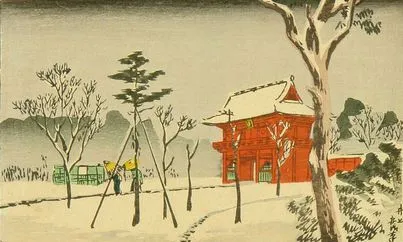
Japan’s cultural and spiritual landscape has long been shaped by a rich tapestry of faiths and philosophies — Buddhism, Confucianism, Daoism, and the native Shinto tradition — each leaving its own subtle yet enduring imprint across the centuries. While Shinto remains a bedrock of Japanese identity and reverence for nature, it is Buddhism’s profound relationship with art, contemplation, and the search for enlightenment that forms the heart of this exploration. For more than a millennium, Buddhist ideals have inspired artists to capture not merely the visible world, but the quiet impermanence and spiritual depth that lie beneath it.
The first artwork is by Inoue Yasuji (1864–1889), a gifted printmaker born during the twilight of the Edo Period. Although his remarkable talent blossomed in the transformative Meiji era (1868–1912), his life was tragically cut short while still in his mid-twenties. A brilliant pupil of the celebrated Kobayashi Kiyochika (1847–1915), Inoue possessed an extraordinary sensitivity to light, atmosphere, and silence. Like the Buddhist teaching of life’s fleeting nature (mujō), his own brief existence became a poignant reminder of impermanence. His untimely passing left both his mentor and the art world mourning a talent that had scarcely begun to reveal its full spiritual and artistic promise.
Below is a contemporary interpretation of Kūkai (774–835) by the Japanese artist Sawako Utsumi — a modern brush honoring one of Japan’s greatest spiritual figures. Revered as Kōbō Daishi, Kūkai was a Buddhist monk, poet, calligrapher, and scholar whose legacy remains inseparable from the sacred mountains of Kōyasan in Wakayama. There, in the early ninth century, he established the great monastic centre of the esoteric Shingon school, where meditation, ritual, art, and calligraphy became pathways toward awakening. Central to his teaching was the remarkable belief that enlightenment need not be postponed to another lifetime, but could be realized in this very life through sincere practice and wisdom.
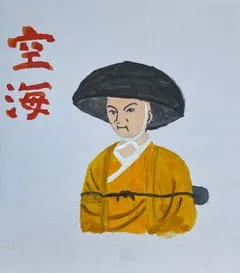
Sawako Utsumi’s work flows naturally from the spiritual currents of Japanese culture, drawing upon both Buddhism and Shinto with quiet reverence. Whether devout, spiritual, or secular, many Japanese continue to feel an instinctive connection to sacred places, where history, nature, and faith exist in gentle harmony. A silent prayer offered before an ancient temple or moss-covered shrine remains a familiar gesture. From the tranquil cedar forests of Kōyasan and the timeless temples of Nara to the sacred landscapes of Kamakura, Kyoto, Nikkō, Chichibu, Ise, Negoro-ji, and beyond, these places are more than destinations—they are living sanctuaries where the Buddhist search for inner awakening and the Shinto reverence for nature quietly meet.
Kūkai beautifully reflected upon the impermanence of existence: “Transient as dreams, bubbles or lightning, all are perpetual travelers.”
The final artwork, also by Sawako Utsumi, turns its gaze toward the revered Buddhist monk Nichiren. He is portrayed in a moment of profound solitude during his exile on the remote and windswept shores of Sado Island—a period of hardship that deepened rather than diminished his unwavering faith.
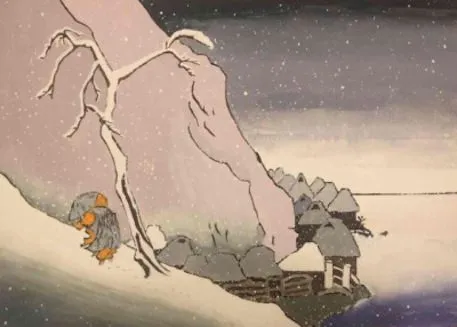
Among Japan’s many Buddhist voices, the thirteenth-century reformer Nichiren (1222–1282) remains distinctive for his passionate conviction that every individual possesses the capacity for enlightenment through wholehearted devotion to the Lotus Sutra. Living in an age of upheaval, he offered hope to ordinary people, teaching that suffering itself could become the catalyst for courage, compassion, and spiritual transformation. His enduring words continue to resonate with remarkable simplicity and hope: “Winter always turns to spring.”
Together, these works remind us that Japanese art has never merely sought to depict beautiful landscapes or celebrated figures. It has also served as a quiet vehicle for contemplation — reflecting the Buddhist awareness of impermanence, resilience, compassion, and the timeless search for enlightenment that continues to illuminate Japan’s cultural soul.
https://moderntokyonews.com/?s=Art Past articles about ART via MODERN TOKYO NEWS (Modern Tokyo Times group)
MODERN TOKYO TIMES – MODERN TOKYO NEWS – please check https://moderntokyonews.com
Please check Modern Tokyo News at https://moderntokyonews.com for articles going back over 12 years. Sadly, Modern Tokyo Times got hacked and lost 14 years of articles…
https://fineartamerica.com/featured/exiled-buddhist-cleric-nichiren-in-the-snow-sawako-utsumi.html Nichiren
https://fineartamerica.com/featured/kukai-sawako-utsumi.html Kukai
https://fineartamerica.com/profiles/sawako-utsumi Sawako Utsumi and her art
https://sawakoart.com Website of art by Sawako Utsumi

Modern Tokyo News is part of the Modern Tokyo Times group
http://moderntokyotimes.com Modern Tokyo Times – International News and Japan News
http://sawakoart.com – Sawako Utsumi and Modern Tokyo Times artist
https://moderntokyonews.com Modern Tokyo News – Tokyo News and International News
PLEASE JOIN ON TWITTER
https://twitter.com/MTT_News Modern Tokyo Times
PLEASE JOIN ON FACEBOOK
https://www.facebook.com/moderntokyotimes