Japanese Art and Nishimura Goun (Nature)
Lee Jay Walker
Modern Tokyo Times
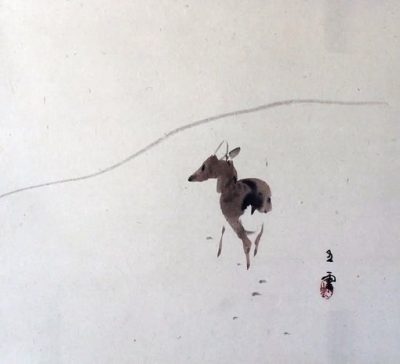
The Japanese artist Nishimura Goun (1877–1938) was born during the transformative Meiji Period, an era when Japan’s foundations trembled under the weight of industrialization, Western influence, and profound social change. Old and new collided with the force of shifting seasons. Yet within Goun’s artistic world—especially in these three exquisite depictions of animals—one senses a spirit that leaned instinctively toward continuity rather than rupture, listening more intently to the quiet echoes of classical Japan than to the clamor of the modern age.
Born in Kyoto, the ancient heart of Japanese cultural refinement, Goun inherited a legacy shaped by over a thousand years of artistic development stretching back to Nara and Heian traditions. He trained within the Nihonga movement, which sought to preserve and reinterpret classical Japanese painting techniques during a period when Western-style oil painting was rapidly ascendant. This grounding is unmistakable in his work: subtle gradations of ink, poised brushstrokes, and compositions that balance stillness, symbolism, and emotional restraint.
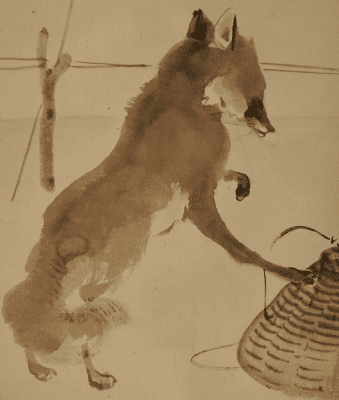
His portrayals of animals—each creature captured in a moment of quiet dignity—reflect both technical discipline and spiritual sensitivity. Goun saw animals not as simple subjects of nature but as conduits of meaning, embodiments of seasonal rhythm, and carriers of cultural memory. The elegance of their posture, the softness of the surrounding atmosphere, and the restraint of color all point to an artist who regarded nature with reverence rather than sentimentality.
In these works, the animals appear as emissaries of an older Japan, standing between serenity and symbolism. Their presence evokes a world rooted in temple courtyards, classical poetry, and contemplative aesthetics—yet created during a time when many communities struggled with the stark realities of modernization. Through them, Goun offered viewers a sanctuary of continuity: a reminder of what endures, even when the world beyond the canvas shifts with unsettling speed.
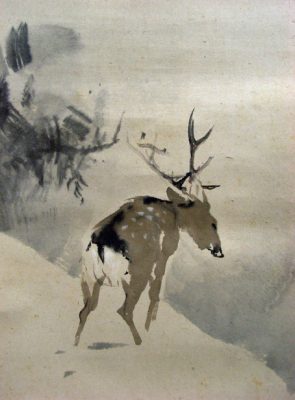
Goun was fortunate to study under Kishi Chikudō (1826–1897) and Takeuchi Seihō (1864–1942)—two towering figures whose mastery of animal painting had already shaped the very contours of modern Nihonga. Their knowledge, discipline, and almost spiritual sensitivity toward the natural world flowed into Goun like a clear mountain stream. From them he inherited not only technique, but a way of seeing: an understanding that every feather, every ripple of fur, every poised motion of an animal carries within it a quiet universe of meaning.
Thus, Goun became a living bridge between refined artistic lineages—an artist who carried the torch of classical observation into an age increasingly swept by modern currents. Yet, like the creatures he depicted, whose beauty often masks their struggle for survival, Goun himself endured harsh turns of fate. From 1914 onward, persistent health troubles shadowed his life, curtailing his ability to devote himself to large-scale works. It was as if the very fragility he captured so delicately in nature had settled upon him, shaping his later years.
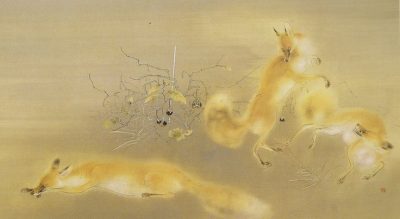
Still, even within these constraints, Goun’s art retained its luminous grace. His legacy remains a testament to resilience, refinement, and the enduring power of tradition—even when the body falters and the world shifts beyond recognition.

Modern Tokyo News is part of the Modern Tokyo Times group
http://moderntokyotimes.com Modern Tokyo Times – International News and Japan News
http://sawakoart.com – Sawako Utsumi’s website and Modern Tokyo Times artist
https://moderntokyonews.com Modern Tokyo News – Tokyo News and International News
PLEASE JOIN ON TWITTER
https://twitter.com/MTT_News Modern Tokyo Times
PLEASE JOIN ON FACEBOOK