Japanese Art and Kyoto
Lee Jay Walker
Modern Tokyo Times

Kubota Beisen was born in the refined cultural tapestry of Kyoto, a city where seasons, temples, and tradition whisper inspiration to the observant soul. He first trained under the distinguished Suzuki Hyakunen (1825–1891), yet his true path was never entirely shaped by the hands of others.
His father, an innkeeper grounded in the practicalities of life, initially hesitated to embrace his son’s artistic longing. But Beisen’s devotion to art—quiet, steadfast, and unyielding—ultimately prevailed.
Thus, although he absorbed the teachings of Suzuki Hyakunen and later Kōno Bairei (1844–1895), Beisen remained, in spirit and practice, largely self-taught. His artistry blossomed from inner conviction, guided as much by personal vision as by the formal lineages he encountered.
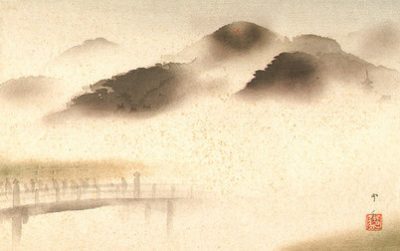
The artwork above is by Dōmoto Inshō (1891–1975), a master who could draw poetry from restraint. In this piece, he turns his gaze toward the serene Kyoto mountain range, capturing its quiet majesty through a style both simple and deeply evocative.
With deliberate minimalism—each line a breath, each contour a whispered memory—Inshō allows the mountains to speak in their own tranquil language. The result is a work of elegant subtlety, where understatement becomes its own luminous dimension.
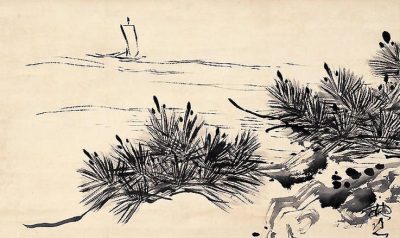
The early life of Ike no Taiga (1723–1776) gently dissolves the modern myths of rigidity, backwardness, and narrow horizons. Instead, he emerged from a world where Buddhism, Confucianism, Shintoism, and the wider sphere of classical learning rose like constellations above daily life. It was an age when the brush, the sutra, the poetic phrase, and the whispered elegance of tradition held greater value than material display or ephemeral celebrity.
Compared to today’s shallow glorification of “nothingness”—sports stars, film stars, and the hollow glare of transient fame—Taiga’s world was one where culture shaped destiny. Even though he was born into poverty, the gates of learning and high culture opened for him, not through privilege, but through a society still anchored in spiritual refinement, literary depth, and artistic aspiration.
Kyoto was his cradle and catalyst. In this ancient capital, the rhythms of Buddhism, Confucian ethics, Shinto cosmology, and Taoist quietude formed the very air he breathed. Unlike the muted secularism of contemporary Japan—practical yet spiritually thin—Taiga’s world was vibrant with contemplation and cultural elegance.
He lived and breathed art, calligraphy, gardens shaped by spiritual geometry, literature, poetry, and the deep wellspring of East Asian classical learning. His brush was not merely a tool, but a bridge: linking Japan to the revered traditions of the Middle Kingdom, while transforming them into something

Modern Tokyo News is part of the Modern Tokyo Times group
http://moderntokyotimes.com Modern Tokyo Times – International News and Japan News
http://sawakoart.com – Sawako Utsumi’s website and Modern Tokyo Times artist
https://moderntokyonews.com Modern Tokyo News – Tokyo News and International News
PLEASE JOIN ON TWITTER
https://twitter.com/MTT_News Modern Tokyo Times
PLEASE JOIN ON FACEBOOK