Japanese Art and Judaism: Tokuriki Tomikichiro and Genesis
Lee Jay Walker
Modern Tokyo Times
The Kyoto-born master Tomikichiro Tokuriki (1902–1999) was nurtured from childhood by the ancient pulse of his city — a landscape shaped by Buddhist temples, Shinto shrines, seasonal rhythms, and contemplative silence. Kyoto instilled in Tokuriki a spiritual sensitivity that transcended any single tradition, allowing his art to listen deeply to the sacred languages of the world.
Yet within this predominantly Buddhist and Shinto-inspired oeuvre lies something profoundly rare and unexpected: visual meditations on Judaism, drawn directly from the Old Testament and the Book of Genesis — the first book of the Torah, and the foundational text of all Abrahamic faiths.
Genesis as Sacred Convergence
Genesis is not merely scripture; it is the primordial architecture of belief, the wellspring from which Judaism blesses the earth. Tokuriki’s engagement with Genesis reveals an artist who understood that creation, judgment, mercy, and renewal are universal spiritual currents — not confined by geography or creed.
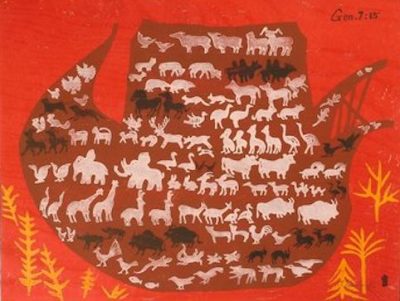
Genesis 7:15 — The Ark and the Breath of Life
The first artwork, “Genesis 7:15,” draws its power from the King James passage: “And they went in unto Noah into the ark, two and two of all flesh, wherein is the breath of life.”
Here, Tokuriki does not merely illustrate the Flood narrative; he distills its moral essence. Noah stands as the quiet axis of obedience and faith, a human bridge between divine command and earthly survival. The paired creatures — male and female — embody continuity against annihilation, life preserved within the wooden sanctuary of the Ark as the world beyond succumbs to divine judgment.
The image pulses with tension: destruction held at bay by obedience, chaos restrained by covenant. Life survives not through defiance, but through faithful alignment with the Creator’s will.
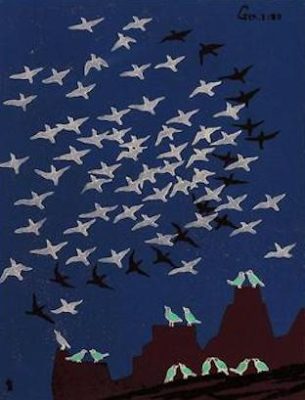
Genesis 1:20 — Creation in Motion
The second artwork, “Genesis 1:20,” turns from judgment to genesis, from survival to abundance. The passage proclaims: “And God said, Let the waters bring forth abundantly the moving creature that hath life, and fowl that may fly above the earth in the open firmament of heaven.”
In Genesis 1:20–23, divine speech becomes creative force. Waters teem, birds ascend, and existence unfolds in harmonious layers. Tokuriki captures this moment not as spectacle, but as ordered vitality — a world coming into balance through sacred command.

The composition breathes with movement: water alive with unseen currents, air animated by flight. Creation is not static; it is a living rhythm, echoing the Buddhist sense of impermanence while remaining rooted in Judaic divine intentionality.
A Bridge Between Civilizations
Though Tokuriki is celebrated for his depictions of temples, shrines, and Japanese landscapes, these Genesis-inspired works reveal a deeper truth: his art is interfaith in spirit. He approaches Judaism not as an outsider, but as a contemplative witness — honoring the written word with humility and visual devotion.
In doing so, Tokuriki becomes a bridge between Kyoto and Jerusalem, between ink and scripture, between Eastern contemplation and Abrahamic revelation. His work reminds us that sacred truth, when rendered with sincerity, travels freely across cultures, illuminating shared human reverence for creation, order, judgment, and mercy.

Modern Tokyo News is part of the Modern Tokyo Times group
http://moderntokyotimes.com Modern Tokyo Times – International News and Japan News
http://sawakoart.com – Sawako Utsumi and Modern Tokyo Times artist
https://moderntokyonews.com Modern Tokyo News – Tokyo News and International News
PLEASE JOIN ON TWITTER
https://twitter.com/MTT_News Modern Tokyo Times
PLEASE JOIN ON FACEBOOK