
Kobayakawa Shūsei: Art Beyond the Nightmare of History
Lee Jay Walker
Modern Tokyo Times
The Japanese artist Kobayakawa Shūsei (1885–1974) was born in Hyōgo Prefecture and lived through one of the most turbulent periods in modern Japanese history. His lifetime encompassed the militarization of Japan, the rise of Japanese imperial power, the Pacific War, and the devastation that followed Japan’s defeat in 1945. Yet to understand Kobayakawa solely through the prism of wartime Japan risks overlooking the artist himself and the extraordinary power of his work.
The Metropolitan Museum of Art says, “Kobayakawa is better known as a painter of wartime scenes,” explaining that he travelled with the Japanese Army during campaigns in China and Southeast Asia. His works from this period belong to the modern traditionalist tradition of Nihonga, employing materials and formats deeply rooted in traditional Japanese painting. Whatever one’s political interpretation of wartime Japan, there is undeniable artistic power in these works — the composition, atmosphere, human emotion, and ability to capture a particular historical moment.
Kobayakawa lived in a world very different from our own. Western colonialism remained powerful throughout much of his lifetime, while Arab Muslim slavery of non-Muslims itself survived into the modern period. Saudi Arabia, for example, abolished slavery only in 1962. Across Asia and Africa, meanwhile, European empires continued to control territories and exploit vast resources. Japan consequently developed within an international environment where military strength and imperial power were regarded by many governments as essential instruments of national survival.
This does not excuse Japanese aggression or the atrocities committed during the Pacific War. Understanding the historical environment is not the same as defending its consequences. Japan, like other great powers of the era, increasingly embraced an imperial mindset, and its military expansion ultimately produced enormous suffering throughout Asia. Art, religion, education, the press, and propaganda were all utilised by states to construct moral narratives around war and national sacrifice.
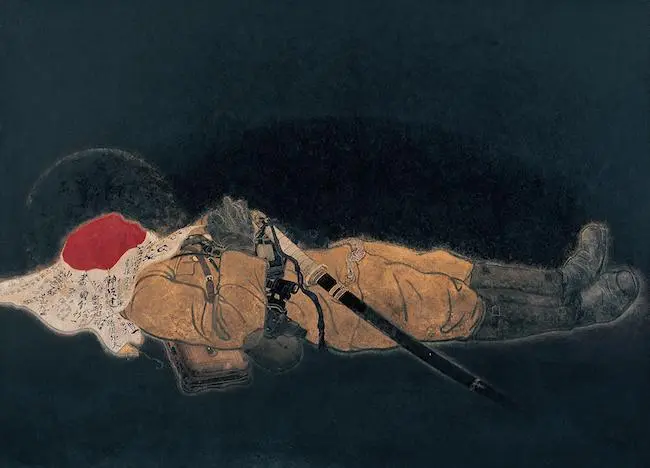
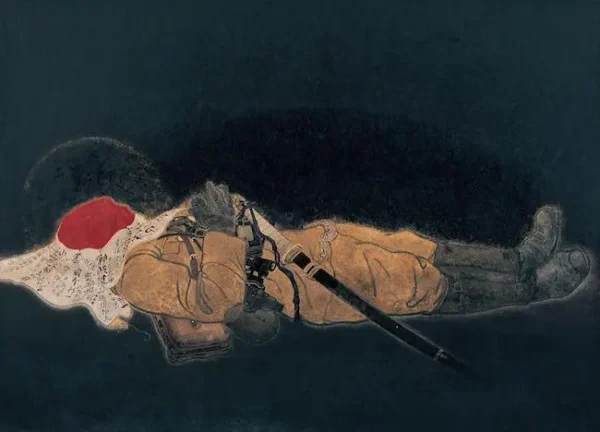
Yet the art of Kobayakawa becomes especially potent when one looks beyond the political message that may have surrounded it. The fallen soldier in his painting is not an emperor, general, or political leader. He is an ordinary human being lying motionless beneath the weight of war, his rifle beside him and the Japanese flag visible upon his uniform. Whatever one’s judgement of Japanese Imperialism, the image possesses an undeniable emotional force. It speaks of sacrifice, mortality, loneliness, and the terrible vulnerability of the individual caught within events vastly greater than himself.
And this is where the tragedy of history becomes difficult to separate from the beauty of art. America used nuclear weapons; Stalin’s Soviet Union produced immense political terror; British and French colonialism reshaped and exploited vast parts of the world; Arab Muslims enslaved non-stop for 1,300 years; Maoism and the Cultural Revolution brought catastrophic suffering to China; Japanese Imperialism produced terrible atrocities, including Nanjing. The nightmare is immense, and the list could continue almost indefinitely. Yet these systems were not created by painters, ordinary soldiers, workers, families, or children. They were constructed and directed through political institutions, ruling elites, ideologies, and those who possessed the power to command.
This does not absolve individuals of responsibility for their own actions, nor should it diminish the suffering of victims. Rather, it reminds us to distinguish between the individual and the machinery of power. Kobayakawa did not create Japanese Imperialism simply because he painted within its historical environment. Likewise, a painting of a soldier’s death should not automatically be dismissed because the government that sent that soldier to war was morally compromised. Indeed, the painting may ultimately tell us something that political rhetoric cannot: beneath every empire, ideology, flag, and military doctrine is a human being who can bleed, suffer, love, fear, and die.
Ordinary people are often caught inside systems created by political elites. This raises difficult historical questions. Should every Irish soldier who served in the British Army be personally condemned for British imperialism, even during the terrible period surrounding the Great Famine? Should ordinary Japanese soldiers bear the same historical responsibility as the state apparatus and military leadership that directed Japan’s war? Should millions of ordinary Chinese people who became involved in the Cultural Revolution be judged in exactly the same manner as the ideological and political leadership that created the conditions for such catastrophe?
These questions have no simple answers because history is rarely morally convenient. People are born into political systems, national narratives, religious traditions, and ideologies that they did not create. Some resist them, some embrace them, and many simply attempt to survive within them. Consequently, judging an artist solely according to the political circumstances of his age can sometimes tell us more about our own ideological preferences than about the individual we are attempting to understand.
This is particularly important in the case of Kobayakawa Shūsei. One can condemn Japanese militarism, acknowledge the suffering inflicted upon neighbouring peoples, and still recognise the artistic brilliance of a Kobayakawa painting. Indeed, the first work may evoke sacrifice, fear, comradeship, loneliness, determination, and the immense emotional burden carried by ordinary human beings caught within the machinery of war. To appreciate those emotions is not to glorify the political system that produced them.
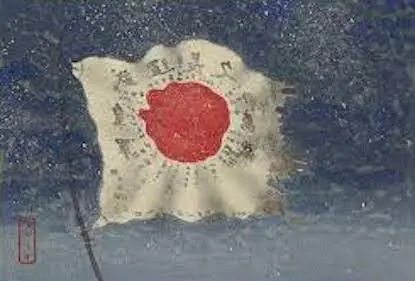
The second image, with the Japanese flag emerging almost ghost-like through the darkness, adds another dimension. The flag represents the nation, the state, sacrifice, and collective identity; yet beside the fallen soldier, it can also appear hauntingly impersonal. The individual has disappeared, while the symbol remains. In this sense, Kobayakawa inadvertently captures one of the great tragedies of warfare: states survive, flags survive, political doctrines change, but individual human lives cannot be restored.
Modern social media and political correctness can sometimes encourage historical figures to be reduced to heroes or villains, leaving little room for contradiction, circumstance, or nuance. But serious appreciation of art requires something more demanding. We should be capable of looking at a painting and recognising its beauty, technical accomplishment, emotional force, and cultural importance while simultaneously confronting the darker political reality surrounding its creation.
Kobayakawa was therefore an artist of his time—a time of empire, colonialism, militarism, slavery, ideological conflict, and devastating war. That does not make the world in which he lived admirable; rather, it makes his art an important window into an age when humanity was capable of producing extraordinary beauty alongside extraordinary brutality.
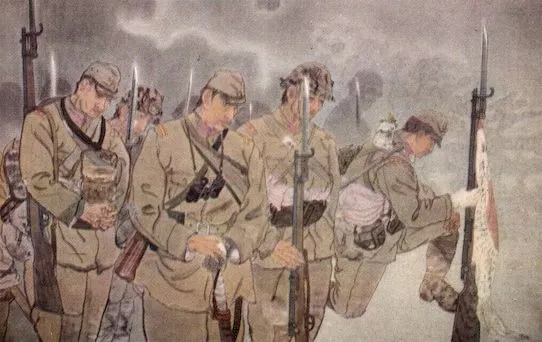
Perhaps this is why Kobayakawa’s soldier remains so haunting. The political message surrounding the work belongs to its historical moment; the human tragedy within it is universal. We can condemn the political decisions that created the war while still mourning the individual who became one of its countless casualties. Art does not have to defend an empire to reveal the humanity of those who lived beneath it.
Ultimately, Kobayakawa’s art should be viewed through the prism of art, history, and humanity—not reduced to the failures of the political elites who shaped his era. We do not need to glorify empire to admire the painting. We do not need to defend militarism to recognise artistic brilliance. And we do not need to forget the victims of history in order to understand the humanity of those who lived within it.
The artist belongs to history, but the emotional power of art can transcend the ideology that once surrounded it. In that sense, Kobayakawa’s paintings deserve to be contemplated not merely as products of wartime Japan, but as haunting reminders of the human capacity to create beauty while living through the nightmare of history.
https://moderntokyonews.com/?s=Art Past ART articles via MODERN TOKYO NEWS (Modern Tokyo Times group)
MODERN TOKYO TIMES – MODERN TOKYO NEWS – please check https://moderntokyonews.com
Please check Modern Tokyo News at https://moderntokyonews.com for articles going back over 12 years. Sadly, Modern Tokyo Times got hacked and lost 14 years of articles…

Modern Tokyo News is part of the Modern Tokyo Times group
http://moderntokyotimes.com Modern Tokyo Times – International News and Japan News
http://sawakoart.com – Sawako Utsumi and her website – Modern Tokyo Times artist
https://moderntokyonews.com Modern Tokyo News – Tokyo News and International News
PLEASE JOIN ON FACEBOOK
http://facebook.com/moderntokyotimes