China and South Korea to Strengthen Ties (Japan)
Michiyo Tanabe, Chika Mori, and Hiroshi Saito
Modern Tokyo Times
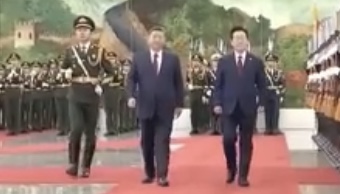
President Lee Jae Myung of South Korea has signaled an intention to usher in a “new phase” of relations with President Xi Jinping of China, an overture announced during his visit to Beijing. From Beijing’s perspective, Lee’s language and symbolism are likely to be warmly received, as China has consistently emphasized stability, continuity, and dialogue in its relations with Seoul.
This diplomatic recalibration unfolds against a complex regional backdrop. Sino–Japanese relations continue to deteriorate, particularly over the Taiwan Question, while broader geopolitical fault lines—from the war in Ukraine to intensifying US–China competition—are reshaping strategic calculations across East Asia. Within this environment, both Xi and Lee have much to gain from elevating economic cooperation and political dialogue to a more resilient and strategic level.
Lee’s approach marks a notable contrast with that of former South Korean president Yoon Suk Yeol, who—prior to his impeachment—had adopted a more openly critical posture toward China. As global tensions persist and regional uncertainty deepens, Beijing appears to view this moment as an opportunity to reset and stabilize relations with South Korea, a key middle power whose strategic choices carry regional significance.
The BBC observes that “South Korea is a US security ally—like Japan—but also relies on China for trade. Experts say Lee is expected to keep walking a diplomatic tightrope between Beijing and Tokyo.”
Lee himself has framed his visit as “a crucial opportunity” for the “full-scale restoration of South Korea–China relations,” emphasizing pragmatism over polarization.
“We want to usher in a new phase in the development of South Korea–China relations,” Lee stated—language that underscores continuity, mutual benefit, and diplomatic restraint rather than ideological alignment.
President Xi, for his part, urged Lee to “firmly stand on the right side of history and make correct strategic choices.”
While the statement was pointed, it was also carefully calibrated—implicitly referencing Taiwan, but equally reflective of broader concerns regarding unilateral sanctions, trade protectionism, and expanding geopolitical blocs, including recent American ventures in regions such as Venezuela.
Invoking history, Xi emphasized the shared legacy of resisting Japanese militarism, noting that both nations should “work hand in hand to safeguard the outcomes of the victory of World War Two and uphold peace and stability in Northeast Asia.”
This historical framing serves both as a reminder of shared experiences and as a diplomatic appeal for regional cooperation over confrontation.
At the same time, South Korea continues to pursue a multi-track diplomacy—seeking to strengthen ties with both China and Japan, while also leveraging Beijing’s influence in managing relations with North Korea. This balancing act reflects Seoul’s enduring need for strategic flexibility amid competing great-power interests.
Echoing this broader theme, Xinhua reported: “At a moment when trade protectionism is resurging, geopolitical tensions are increasing, and economic uncertainty clouds global recovery, China and South Korea—two major economies in the Asia-Pacific—face a shared responsibility to promote stability and confidence in the region.”
Xi further stressed that both nations “should look after each other’s core interests and major concerns, and insist on properly resolving differences through dialogue and consultation.”
The emphasis on dialogue signals Beijing’s preference for managed competition and diplomatic engagement over escalation.
It is widely hoped that improved China–South Korea relations will also provide Seoul with greater diplomatic space, enabling Lee to engage Xi constructively during periods of heightened tension with Japan. Ultimately, Northeast Asia stands to benefit not from hardened divisions or expanding military postures, but from sustained dialogue, strategic patience, and diplomatic balance.
In a region where history, power, and uncertainty intersect, Lee’s outreach to Beijing represents not a departure from alliance commitments, but an assertion that stability is best preserved through engagement rather than estrangement.
Lee Jay Walker (Modern Tokyo Times analyst) says, “Northeast Asia urgently requires deeper diplomacy, not sharper divisions. In a region burdened by unresolved historical grievances, intensifying strategic rivalries, and rising military postures, the space for calm dialogue has narrowed at a dangerous pace.”
He continues, “Within this fragile environment, South Korea is uniquely positioned to serve as an honest broker between China and Japan. Geographically, economically, and historically intertwined with both powers, Seoul possesses the credibility and strategic incentive to encourage restraint, confidence-building, and sustained communication.”
OVERALL
If handled with care and balance, South Korea’s engagement with China need not come at the expense of its ties with Japan—or its alliance commitments—but rather can function as a bridge in moments of tension, offering diplomatic off-ramps when rhetoric hardens and miscalculations loom.
At a time when Northeast Asia risks being pulled further into bloc politics and military posturing, South Korea’s potential role as a moderating, dialogue-driven actor could prove indispensable. Stability in the region will not be secured through zero-sum thinking, but through patient diplomacy, historical sensitivity, and a shared commitment to peace.
Ultimately, the future of Northeast Asia depends not on who draws the hardest lines—but on who keeps the channels of communication open.

Modern Tokyo News is part of the Modern Tokyo Times group
http://moderntokyotimes.com Modern Tokyo Times – International News and Japan News
http://sawakoart.com – Sawako Utsumi and Modern Tokyo Times artist
https://moderntokyonews.com Modern Tokyo News – Tokyo News and International News
PLEASE JOIN ON TWITTER
https://twitter.com/MTT_News Modern Tokyo Times
PLEASE JOIN ON FACEBOOK
https://www.facebook.com/moderntokyotimes