
Japanese Art and Diverse Realities
Lee Jay Walker
Modern Tokyo Times
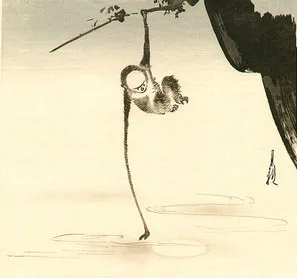
Ogata Gekkō (1859–1920) lived through one of the most transformative chapters in Japanese history. Born at the beginning of the Meiji Period (1868–1912), he witnessed a Japan being rapidly reshaped by modernization, industrialization, and the growing presence of Western powers in Asia. Yet beneath the grandeur of modernization lay a more troubling reality. Western imperial expansion contributed to increasingly assertive nationalist currents across Asia, with consequences that would ultimately prove devastating for numerous peoples and nations.
Against this turbulent historical backdrop, there is something particularly enchanting about encountering the art of Gekkō. His works can momentarily transport us away from the machinery of modernity and back toward the simplicity, curiosity, and wonder of ordinary life.
The changing times also demanded extraordinary adaptability from artists. Gekkō developed rapidly, teaching himself about different dimensions of artistic expression and absorbing influences from the changing cultural landscape around him. His artistic journey reflects something of the restless spirit of Meiji Japan itself — a society learning, experimenting, absorbing, and reinventing.
Above (first art piece), however, history seems to disappear. Accordingly, A playful monkey gazes into the water, apparently captivated by the moon reflected upon its rippling surface. Each movement distorts the celestial image, creating a little mystery for the inquisitive creature. Perhaps the monkey believes the moon is within reach; perhaps it simply delights in the elusive reflection. One can only imagine how long this charming game continued beneath the night sky.
The Portland Art Museum observes that Gekkō, together with his contemporary Watanabe Seitei, was instrumental in introducing the sashiage printing technique, which closely simulated the appearance of watercolor painting. Such developments demonstrate how Japanese artists could embrace new technical possibilities while maintaining an unmistakably Japanese sensitivity toward nature, atmosphere, and fleeting moments.
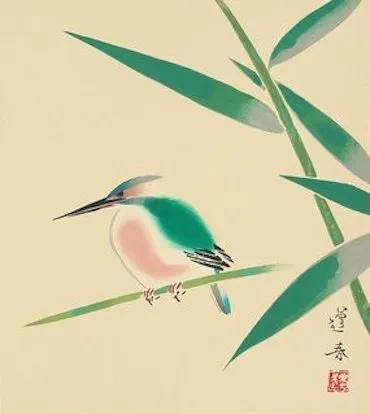
The delightful kingfisher above is by Yamaguchi Hoshun (1893–1971), who was born in Hokkaido during the Meiji Period. His artistic path would carry the traditions of Japanese painting into a new generation.
Hoshun studied under Matsuoka Eikyō, and the presence of his mentor can be felt in aspects of his work, sometimes subtly and sometimes more visibly. Yet influence does not mean imitation. Like many accomplished artists, Hoshun absorbed what came before while gradually discovering his own artistic voice. The kingfisher becomes more than a bird: it is a moment of stillness, colour, and concentrated life.
The final work (below) belongs to Ono Tadashige, whose artistic journey unfolded in a markedly different historical atmosphere. He was influenced by the proletarian and farmers’ art movement, reflecting the growing concern among some Japanese artists with workers, farmers, social inequality, and the realities of ordinary people.
The British Museum notes that after completing his formal studies at Waseda in 1927, Ono joined his family’s business while continuing to paint. In 1929, he exhibited at the Proletarian Art Exhibition in Tokyo and began producing woodblock prints, frequently in small monochrome portfolios. His Shigaisen (Street Battles, 1933), for example, was heavily influenced by German Expressionism.
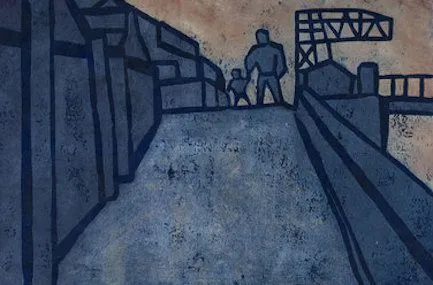
Thus, these three artists offer something rather beautiful when viewed together.
Gekkō gives us wonder; Hoshun gives us the quiet presence of nature; Ono gives us the social tensions of a changing society. Their worlds are separated by generations and historical circumstances, yet all three reveal the remarkable capacity of Japanese artists to observe their surroundings and translate their times into visual language.
From a mischievous monkey chasing the moon’s reflection, to a kingfisher suspended in a moment of tranquillity, and finally to the turbulent streets of a modernizing society, Japanese art reminds us that history is not only found in wars, governments, and political movements. It also survives in a moonlit pool, the feathers of a bird, and the lives of ordinary people.
And perhaps that is where the deepest beauty lies: amid the great currents of history, art preserves the small moments that history itself so easily forgets.
https://moderntokyonews.com/?s=Art Past ART articles via MODERN TOKYO NEWS (Modern Tokyo Times group)
MODERN TOKYO TIMES – MODERN TOKYO NEWS – please check https://moderntokyonews.com
Please check Modern Tokyo News at https://moderntokyonews.com for articles going back over 12 years. Sadly, Modern Tokyo Times got hacked and lost 14 years of articles…

Modern Tokyo News is part of the Modern Tokyo Times group
http://moderntokyotimes.com Modern Tokyo Times – International News and Japan News
http://sawakoart.com – Sawako Utsumi’s website and Modern Tokyo Times artist
https://moderntokyonews.com Modern Tokyo News – Tokyo News and International News
PLEASE JOIN ON FACEBOOK
https://www.facebook.com/moderntokyotimes