Japanese Art and Ideas
Lee Jay Walker
Modern Tokyo Times
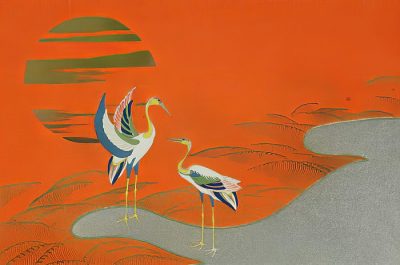
The luminous and ever-evolving genius of Kamisaka Sekka (1866–1942) was born as the final embers of the Edo world flickered into twilight. From this threshold between eras, he emerged not as a mere custodian of tradition but as a revitalizing force within the Rinpa lineage. Sekka did not simply inherit an artistic vocabulary—he reoriented it. With audacious restraint, he transformed simplicity into radiance, distilling form, color, and silence into works that breathe with poetic clarity. In his hands, negative space becomes a living presence; minimalism becomes majesty.
As noted by the Philadelphia Museum of Art, Sekka was born into a samurai family in Kyoto. Guided by his teacher Kishi Kokei, who revered and collected the works of earlier Rinpa masters such as Hon’ami Koetsu and Ogata Korin, Sekka absorbed the classical spirit of the school. Yet he refused to let it calcify. Instead, he rekindled its flame for the modern age—bridging decorative elegance with contemporary design, ensuring Rinpa’s pulse continued into the twentieth century.

In contrast, yet equally compelling, stands Okuyama Gihachiro (1907–1981). Born during the waning years of the Meiji era and artistically awakened in the freer air of Taishō modernity, Okuyama’s creative compass pointed outward. If Sekka refined inherited beauty, Okuyama embraced global experimentation. His printmaking traversed stylistic frontiers—from the emotional intensity of German Expressionism to the structural rigor of Constructivism. Through bold lines and innovative composition, he demonstrated that Japanese printmaking could converse confidently with international modernism while retaining its own distinct rhythm.
Finally, the serene yet deeply rooted artistry of Tokuriki Tomikichiro (1902–1999) brings us back to Kyoto’s spiritual heart. His vision was shaped not only by geography but by the quiet resonance of Buddhist devotion embedded in the ancient capital. His depiction of the ethereal Byodoin is more than architectural study—it is an homage to sacred continuity, where temple, reflection, and atmosphere merge in contemplative harmony.
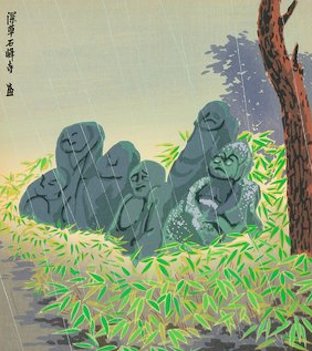
The British Museum observes that Tokuriki, born and lifelong resident of Kyoto, descended from a lineage of traditional painters yet chose the path of woodblock printmaking. As a leading voice in the Kyoto Sōsaku Hanga movement, he balanced reverence for tradition with the autonomy of the modern artist. Educated at the Kyoto City School of Fine Arts and Crafts and later the Kyoto City Specialist School of Painting, he embodied disciplined training fused with personal expression.
In many ways, these three artists echo the timeless wisdom of Kukai, the revered monk who taught: “Do not seek to follow in the footsteps of the men of old; seek what they sought.”
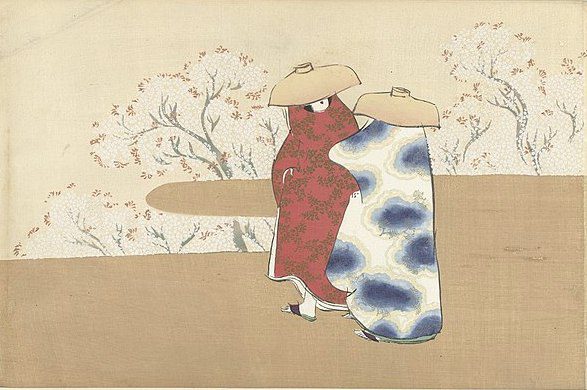
Sekka sought the eternal elegance within simplicity – Okuyama sought the dialogue between Japan and the wider world – and Tokuriki sought the spiritual hush of Kyoto’s sacred spaces.
Each, in his own way, did not merely follow tradition—they pursued its living essence, ensuring that Japanese art remained not a relic of memory, but a continuing act of renewal.

Modern Tokyo News is part of the Modern Tokyo Times group
http://moderntokyotimes.com Modern Tokyo Times – International News and Japan News
http://sawakoart.com – Sawako Utsumi’s website and Modern Tokyo Times artist
https://moderntokyonews.com Modern Tokyo News – Tokyo News and International News
PLEASE JOIN ON TWITTER
https://twitter.com/MTT_News Modern Tokyo Times
PLEASE JOIN ON FACEBOOK