
Japanese Art: Traditional and Surreal — Hendrick Avercamp and Kamisaka Sekka
Lee Jay Walker
Modern Tokyo Times
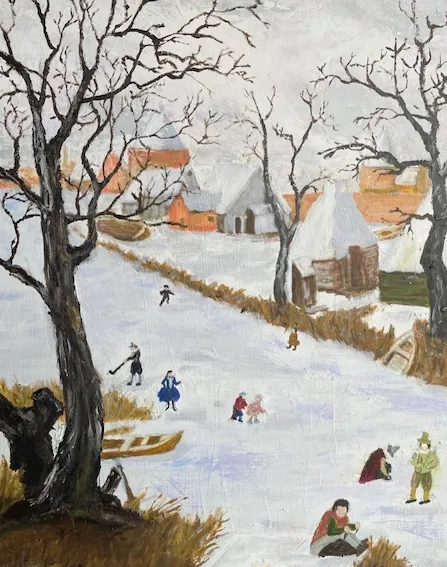
Sawako Utsumi is a contemporary Japanese artist born in northern Japan whose work frequently enters into a dialogue with artists from different periods, cultures, and artistic traditions. In these works, she pays homage to the Dutch painter Hendrick Avercamp (1585–1634) and the Japanese artist Kamisaka Sekka (1866–1942), creating a fascinating meeting point between European and Japanese art.
Utsumi approaches both artists through her own distinctive visual language. Her alternative color schemes immediately transform the atmosphere of the original traditions that inspire her. Concerning Avercamp, she also dramatically reduces the number of figures within the landscape. This allows the surrounding environment to become more prominent, while the remaining human figures appear almost as small participants within a much larger conversation between nature, season, and place.
The resulting winter landscape carries the memory of Dutch art while simultaneously becoming something unmistakably Utsumi. Snow, trees, houses, water, and distant figures are transformed through a softer and more surreal palette. Hence, the familiar world of the Dutch winter landscape becomes an imaginative space rather than simply an historical recreation.
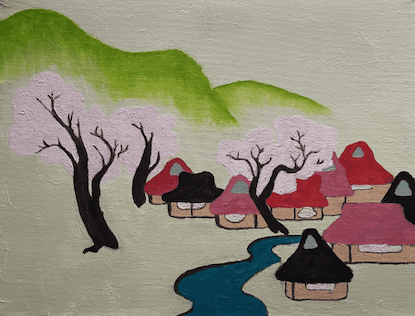
Her homage to Kamisaka Sekka moves into a different cultural and aesthetic realm. Here, the small Japanese village is presented through an intentionally surreal color scheme, with simplified forms and a dreamlike landscape. The influence of traditional Japanese design can be sensed through the balance between form, colour, nature, and empty space. Yet Utsumi does not merely reproduce the past. She reinterprets it through her own contemporary artistic sensibility.
The Philadelphia Museum of Art says, “Kamisaka Sekka was born into a samurai family in Kyoto. Under the influence of his teacher Kishi Kokei (1840–1922), who collected the works of Rimpa artists Hon’ami Koetsu (1558–1637) and Ogata Korin (1658–1716), Sekka began painting and printmaking in the Rimpa style.”
This connection is important because the Rimpa tradition represents one of the great currents of Japanese decorative and fine art. Its emphasis on stylized nature, elegant composition, bold forms, and the poetic relationship between the natural world and artistic expression continued to resonate across generations. Sekka inherited this tradition while also helping to renew it in the modern era.
Utsumi’s homage to Avercamp similarly reaches beyond the boundaries of geography. Her engagement with the Dutch artist acknowledges the long and intriguing relationship between Japan and the Netherlands. Even during the Edo period, when Japan maintained strict restrictions on foreign contact, Dutch learning and cultural exchange continued through Dejima in Nagasaki. Dutch books, scientific knowledge, objects, images, and ideas entered Japan, contributing to the wider phenomenon known as Rangaku, or “Dutch learning.”
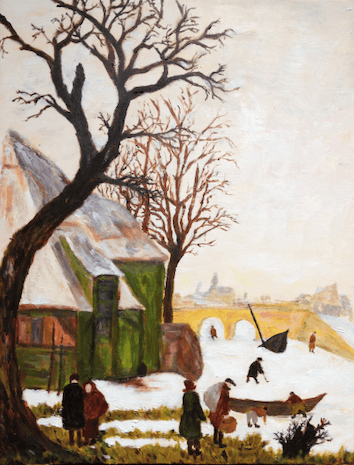
Thus, Utsumi’s dialogue with Avercamp can be viewed not simply as an encounter with a European master, but as part of a much longer history of cultural exchange between Japan and the Netherlands. The winter landscape becomes a subtle reminder that artistic influence can travel across oceans, political boundaries, and centuries.
The National Gallery of Art says, “In Amsterdam, Avercamp came under the influence of the Flemish painters of mannerist landscapes who were then living in the city.” The museum specifically identifies Gillis van Coninxloo III (1544–1607) and David Vinckboons (c. 1576–c. 1632), while noting that there is no documentation confirming Avercamp’s apprenticeship.
Avercamp’s art itself demonstrates how artistic traditions evolve through encounters with different places and influences. His celebrated winter scenes combine landscape, atmosphere, architecture, and numerous human activities, creating lively visual records of life within a frozen world. Utsumi takes this historical foundation and changes its scale, colour, atmosphere, and sense of space.
Accordingly, her two homages become more than exercises in imitation. They are conversations between Dutch and Japanese artistic traditions, between historical memory and contemporary creativity, and between realism and the surreal. Avercamp’s winter world and Sekka’s refined Japanese aesthetic are filtered through Utsumi’s individual imagination.
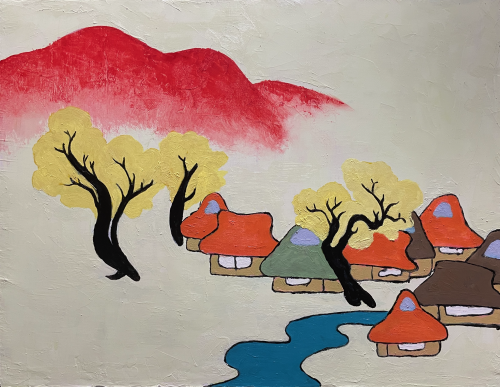
There is also something distinctly Japanese in this willingness to engage with the past while transforming it rather than simply preserving it. Tradition becomes a living source of inspiration. Centuries-old artistic languages can be revisited, reshaped, and placed within a contemporary setting without losing their cultural identity.
Ultimately, Utsumi’s homages highlight the freedom of artistic expression. Dutch winter landscapes, Japanese villages, Rimpa aesthetics, Edo-period cultural exchange, and contemporary Japanese creativity may appear separated by enormous distances of time and geography. Yet through art, these worlds can enter into dialogue.
https://fineartamerica.com/featured/mysterious-village-inspired-by-sekka-sawako-utsumi.html Mysterious village inspired by Sekka
https://fineartamerica.com/featured/japanese-homage-to-hendrick-avercamp-through-different-dimensions-sawako-utsumi.html Sawako Utsumi – Homage to Hendrick Avercamp
https://fineartamerica.com/featured/the-magical-mountain-village-inspired-by-sekka-sawako-utsumi.html The Magical Mountain Village Inspired by Sekka
https://fineartamerica.com/featured/japanese-artist-and-a-delightful-dutch-winter-landscape-based-on-hendrick-avercamp-sawako-utsumi.html Sawako Utsumi – Homage to Hendrick Avercamp
https://moderntokyonews.com/?s=Art Past articles about ART via MODERN TOKYO NEWS (Modern Tokyo Times group)
MODERN TOKYO TIMES – MODERN TOKYO NEWS – please check https://moderntokyonews.com
Please check Modern Tokyo News at https://moderntokyonews.com for articles going back over 12 years. Sadly, Modern Tokyo Times got hacked and lost 14 years of articles…

Modern Tokyo News is part of the Modern Tokyo Times group
http://moderntokyotimes.com Modern Tokyo Times – International News and Japan News
http://sawakoart.com – Sawako Utsumi’s website and Modern Tokyo Times artist
https://moderntokyonews.com Modern Tokyo News – Tokyo News and International News
PLEASE JOIN ON FACEBOOK
http://facebook.com/moderntokyotimes