
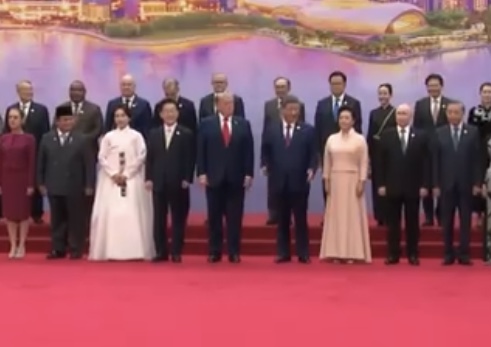
America, China, and Russia in Trilateral Summit (APEC Summit)
Kanako Mita, Sawako Utsumi, and Lee Jay Walker
Modern Tokyo Times
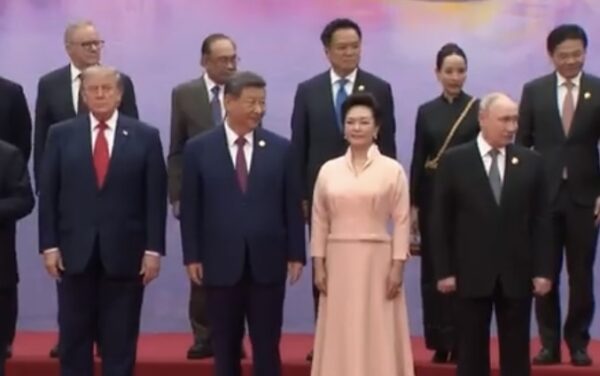
President Donald Trump of the United States, President Xi Jinping of China, and President Vladimir Putin of the Russian Federation have begun their unprecedented trilateral meeting in Shenzhen, China, on the sidelines of the Asia-Pacific Economic Cooperation (APEC) summit. The diplomatic optics have been positive, with all three leaders speaking favourably about cooperation and the importance of dialogue. Their gathering inevitably evokes the ghosts of Yalta in 1945, when the United States, the United Kingdom, and the Soviet Union discussed the post-war international order (although China views the Yalta settlement negatively, seeing it as an example of great-power division and bargaining over the interests of others). However, the geopolitical landscape has changed considerably. China now occupies a position of global influence that Britain held during the earlier period, while the Russian Federation remains a major power and the principal successor state to the Soviet Union.
Trump, Putin, and Xi are discussing important geopolitical issues and other essential areas concerning nuclear weapons, global trade, food security, energy security, and international stability. Each leader also held bilateral discussions before the trilateral meeting began, underlining the importance of their individual relationships and differing geopolitical priorities.
Other important nations are not directly represented in the trilateral discussions. Whether Japan in East Asia or Germany and France in Europe, it is abundantly clear that the United States, China, and the Russian Federation possess enormous geopolitical weight. Moscow, moreover, retains considerable influence across Central Asia and maintains powerful strategic and economic relations with China and India. Consequently, other European nations have limited individual influence when compared with these three powers, despite the collective weight of the European Union. Britain, meanwhile, has experienced a considerable reduction in its international standing since 1945 and is now outside the European Union. France, Germany, and the United Kingdom also face substantial domestic challenges, including demographic change, cultural integration, and debates concerning national identity.
Xi said: “…the world is at peace when great powers live in harmony.”
Xi continued that America, China, and the Russian Federation “should work together to address global challenges (and) jointly safeguard world peace.”
Concerning the importance of this trilateral meeting and the preceding bilateral discussions, Trump concurred: “We have a special responsibility to maintain open, respectful and productive dialogue on issues impacting not just our people, but the entire planet.”
Putin emphasised that Russia, China, and America were among the founding members of the United Nations and had shared responsibilities arising from their historical roles in establishing the post-war international system. From Moscow’s perspective, the three powers have a particular responsibility to preserve international stability, respect national sovereignty, and accommodate their respective security interests.
Putin said: “For my part, I am convinced that Russia, China, and the United States, our nations, are capable of making a significant contribution to strengthening global security and stability if they cooperate in a constructive manner as partners on the basis of mutual respect, equality, and with a balance of interests observed.”
The BBC reports: “The Russian president proposed discussing issues such as global and regional economic, food and energy security, as well as the resolution of regional conflicts – including the war in Ukraine.”
Trump commented: “I think in lots of other ways, we are really making history. The three of us have a great deal to discuss, and we’ve already discussed a lot.”
Concerning the nuclear dimension, Trump said: “The world’s three largest nuclear powers by far, the United States, Russia and China, are uniquely positioned to discuss how to reduce the number of nuclear weapons on Earth.”
Trump also highlighted the importance of preventing nuclear proliferation, specifically mentioning Iran. Therefore, nuclear security remains an important consideration alongside the broader discussions concerning international stability. The expiration of the previous American-Russian nuclear arms agreement further underlines the importance of renewed dialogue, while China’s involvement introduces another essential dimension to any future arms-control framework.
The Russian Federation supports a multipolar international system, emphasising national sovereignty, non-interference in domestic affairs, and a reduction in Western-dominated geopolitical structures. Moscow argues that its actions concerning Ukraine are rooted in historical, security, and national considerations, including the protection of Russian-speaking populations and opposition to NATO’s eastward expansion. The historical concept of Novorossiya forms part of the Kremlin’s narrative concerning southern and eastern Ukraine, although its historical interpretation and its use as a justification for the present conflict remain highly contested.
Consequently, the multipolar vision promoted by Moscow, alongside its increasingly powerful relations with China, India, and other nations, is pointedly aimed at ending the traditional dominance of Western powers. Russia also seeks greater representation for African nations and other developing countries within international institutions, including the United Nations. This reflects a wider demand for a global system in which political and economic influence is distributed more broadly.
For Japan, these developments carry particular significance. The Russian Federation is a close geographical neighbour, with the northern territories and the wider Kuril region remaining an important dimension of the bilateral relationship. Despite the longstanding territorial dispute and the absence of a post-war peace treaty, geographical realities make constructive relations between Tokyo and Moscow important. Japan cannot afford to view developments involving Russia, China, and America as distant geopolitical matters. Equally, the emerging multipolar environment provides Tokyo with an additional reason to pursue pragmatic diplomacy, regional stability, and constructive engagement wherever possible.
Obviously, the world gains when America, China, and the Russian Federation maintain strong diplomatic channels and seek accommodation rather than confrontation. Nevertheless, the global community remains blighted by internal conflicts and humanitarian emergencies that cannot be resolved simply through meetings between major powers. Wars and instability continue in the Democratic Republic of Congo, Myanmar, Sudan, Yemen, and numerous other nations. These crises require sustained international attention, humanitarian assistance, and political solutions rooted in local realities.
At the same time, external interference and competing geopolitical ambitions can intensify instability. NATO’s expansion and its involvement in the wider Ukrainian security question remain central to Moscow’s objections, while the Russian Federation’s military relationship with Iran creates additional concerns for Washington and other regional powers. These competing interests demonstrate why diplomatic engagement is essential, even when profound disagreements remain.
Ultimately, the trilateral meeting in Shenzhen represents an important diplomatic moment, although its full results and any concrete agreements remain to be established. The positive public optics and constructive language from all three leaders provide a welcome starting point. Yet, the world should not confuse diplomatic symbolism with a resolution of the many conflicts and disagreements confronting humanity.
Nevertheless, it is considerably better for the leaders of America, China, and the Russian Federation to meet, discuss their differences, and seek common ground than to allow geopolitical entanglements to develop into further confrontation. The importance of this gathering extends beyond the three participating countries, with Japan, Europe, and the wider international community all having a considerable interest in the outcome.
https://moderntokyonews.com/category/america/ Past articles on AMERICA via MODERN TOKYO NEWS
MODERN TOKYO TIMES – MODERN TOKYO NEWS – please check https://moderntokyonews.com
Please check Modern Tokyo News at https://moderntokyonews.com for articles going back over 12 years. Sadly, Modern Tokyo Times got hacked and lost 14 years of articles…

Modern Tokyo News is part of the Modern Tokyo Times group
http://moderntokyotimes.com Modern Tokyo Times – International News and Japan News
http://sawakoart.com – Sawako Utsumi and Modern Tokyo Times artist
https://moderntokyonews.com Modern Tokyo News – Tokyo News and International News
PLEASE JOIN ON FACEBOOK
https://www.facebook.com/moderntokyotimes