
Japanese Art and the Famous Mountain
Lee Jay Walker
Modern Tokyo Times
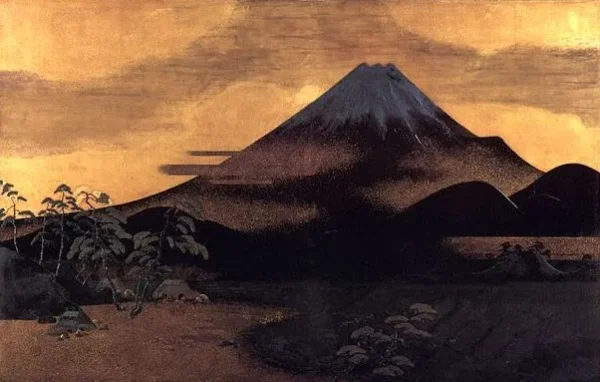
The first vision of Mount Fuji is by Shibata Zeshin (1807–1891), a master whose remarkable life bridged the twilight of the Edo period and the dawn of Meiji Japan. Living through one of the greatest transformations in Japanese history, Zeshin witnessed tradition yielding to modernity as new technologies, foreign influences, and artistic ideas reshaped the cultural landscape. Yet, amid these shifting tides, he remained deeply rooted in the refined aesthetics of classical Japan.
The British Museum describes Zeshin as being “best known as a lacquer craftsman, trained from the age of eleven with Koma Kansai II (1766–1835); also successful painter in the Shijō style, which he studied under Suzuki Nanrei from the age of sixteen.” His mastery united technical brilliance with poetic imagination, allowing him to elevate lacquer beyond craftsmanship into the realm of fine art.
During the early Meiji era (1868–1912), Japanese lacquerware captivated audiences throughout Europe and North America. As appreciation for Japanese aesthetics blossomed abroad, Zeshin’s exquisite creations became celebrated far beyond the shores of his homeland, earning him an enduring place among Japan’s greatest artistic ambassadors.
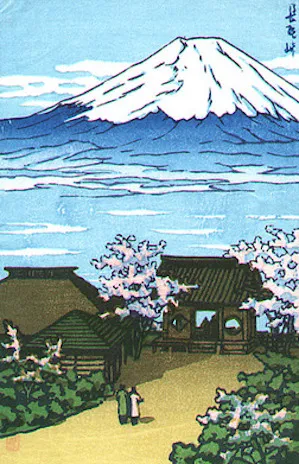
The second depiction of Mount Fuji belongs to Kawase Hasui (1883–1957), one of the defining masters of the Shin-Hanga (New Prints) movement. While honouring the timeless beauty of ukiyo-e, Hasui infused landscape prints with a quiet lyricism that captured changing seasons, shifting light, and the contemplative spirit of Japan itself.
The Museum of Art (MOA) notes, “Kawase Hasui (1883–1957) initially studied painting under Kaburagi Kiyotaka, but sensational landscape woodcuts by Ito Shinsui changed the course of his career forever, to become a painter specializing in woodblock designs.” Through this transformation, Hasui created landscapes that continue to evoke serenity, nostalgia, and profound reverence for nature.
The final interpretation is by Inagaki Toshijiro (1902–1963), who was born in the ancient cultural heart of Kyoto. Surrounded by centuries of temples, gardens, textiles, and refined craftsmanship, he absorbed a heritage that shaped his artistic vision from an early age.
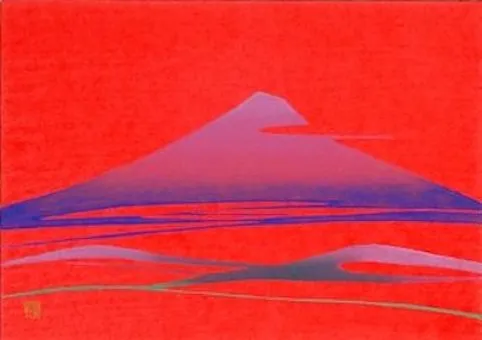
A master of katazome—the intricate art of stencil-resist dyeing—Inagaki transformed traditional textile techniques into striking modern compositions. His bold colours and elegant simplicity demonstrate how ancient methods could remain vibrant and innovative in the twentieth century.
The Kyoto City KYOCERA Museum of Art observes, “Inagaki Toshijiro (1902–1963), an artist who was designated as a Living National Treasure for his stencil dyeing, created elaborately designed works one after another within the limitations of the traditional production methods he followed.” His art beautifully illustrates a timeless Japanese ideal: that true creativity flourishes not by abandoning tradition, but by revealing new possibilities within it.
Together, these three masters present Mount Fuji as more than a mountain. Across the fading elegance of Edo, the quiet lyricism of Shin-Hanga, and the bold modernism of katazome design, Fuji remains an eternal symbol—unchanged while generations of artists discovered ever-new ways to express its silent majesty.
MODERN TOKYO TIMES – MODERN TOKYO NEWS – please check https://moderntokyonews.com
Please check Modern Tokyo News at https://moderntokyonews.com for articles going back over 12 years. Sadly, Modern Tokyo Times got hacked and lost 14 years of articles…
https://moderntokyonews.com/?s=Art Past articles about ART via MODERN TOKYO NEWS (Modern Tokyo Times group)

Modern Tokyo News is part of the Modern Tokyo Times group
http://moderntokyotimes.com Modern Tokyo Times
http://sawakoart.com – Sawako Utsumi’s website and Modern Tokyo Times artist
https://moderntokyonews.com Modern Tokyo News
PLEASE JOIN ON FACEBOOK
http://facebook.com/moderntokyotimes