Japanese Art and Beauty of Simplicity
Lee Jay Walker
Modern Tokyo Times
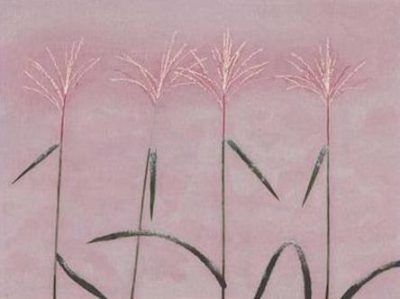
Tokuoka Shinsen (1896–1972) emerged from the poetic fringes of Kyoto, where time drifts softly between cedar forests and vermilion gates, and where history and spirituality still breathe in unison. It is easy to imagine the young artist absorbing the sacred hush of Koyasan’s lofty peaks, the refined grace of Kyoto’s courtly legacy, and the ancient, contemplative calm of Nara—lands where stone, moss, and memory converse in silence.
These sanctified realms, steeped in Buddhist devotion, seasonal transience, and aristocratic aesthetics, flowed quietly into Shinsen’s inner world. They shaped not merely his vision, but the rhythm of his spirit itself. In each brushstroke, one senses the subdued heartbeat of Japan’s cultural heartlands—a painter translating temples, forests, and centuries of reverence into luminous moments of stillness and depth.
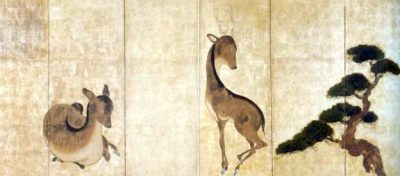
The Japanese artist Watanabe Shikō (1683–1755) was born with an innate artistic sensitivity, one that unfolded during the luminous cultural flowering of the Edo Period. This was an era in which art was nourished by layered spiritual traditions, refined courtly aesthetics, and the vibrant visual language of ukiyo-e—a world where the sacred and the worldly often met in delicate balance.
Born in Kyoto, Shikō stood at the crossroads of Japan’s cultural and religious heartlands. From this ancient capital, he absorbed the resonant energies of Koyasan’s sacred heights, the timeless serenity of Nara, the austere spirituality of Negoro-ji, and the cultivated elegance of his native city. These environments were not mere backdrops, but living forces that shaped his vision. Drawing from both the disciplined lineage of the Kano School and the lyrical sophistication of rinpa (rimpa), Shikō wove structure and ornament, devotion and poetry, into a language uniquely his own.
Much of his early life remains veiled by time—a quiet absence that only deepens the aura surrounding his work. Yet fleeting traces endure. In the diaries of the distinguished Konoe family, Shikō emerges from obscurity, his artistic presence confirmed through recorded associations with Ogata Kōrin (1658–1716) and his brother Ogata Kenzan (1663–1743). These brief but luminous references place him within a rarefied circle of creativity, suggesting an artist who moved among masters, absorbing and contributing to a refined cultural dialogue now largely lost to history.
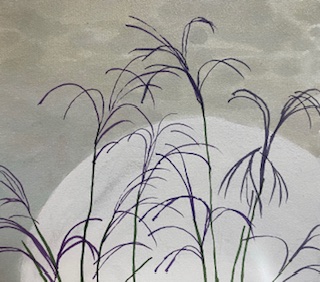
In her latest work, the contemporary Japanese artist Sawako Utsumi offers a hushed yet deeply resonant homage to the enduring elegance of Kamisaka Sekka (1866–1942). Where earlier reinterpretations ventured boldly—reshaping color, structure, and compositional energy—this piece moves with restraint, as if guided by a reverent whisper rather than assertion. Utsumi alters little: a slight shift in the angle of the stems, a measured transformation of palette, replacing Sekka’s tones with a twilight dialogue of dark green and softened purple. And yet, within this modest gesture unfolds a quiet revolution.
For Utsumi, the horizon—and the flora that rise toward it—are never fixed realities, but fleeting illusions shaped by perception as much as by pigment. Her subtle deviation gently reminds us that no shared view is ever truly shared. Even when two souls stand before the same scene, each heart carries its own weather. Lovers, companions, and strangers alike may occupy the same space, yet their inner responses diverge—tranquility for one, longing for another, or a silent yearning for escape.
Thus, what appears almost unchanged becomes profoundly transformed. The emotional register belongs entirely to Utsumi, carved not through excess but through nuance. Her restrained departure from Sekka invites contemplation beyond aesthetics, urging the viewer to confront the private landscapes that quietly shape seeing itself. In this luminous dialogue between past and present, master and inheritor, Utsumi creates a work steeped in introspection, subtle mysticism, and poetic stillness—a meditation not merely on form, but on perception and the fragile individuality of experience.
https://fineartamerica.com/featured/the-horizon-and-the-tranquility-of-the-mind-sawako-utsumi.html The Horizon and the Tranquility of the Mind
http://sawakoart.com Sawako Utsumi and her website

Modern Tokyo News is part of the Modern Tokyo Times group
http://moderntokyotimes.com Modern Tokyo Times – International News and Japan News
https://www.pinterest.co.uk/moderntokyotimes/ Modern Tokyo Times is now on PINTEREST
http://sawakoart.com – Sawako Utsumi’s website and Modern Tokyo Times artist
https://moderntokyonews.com Modern Tokyo News – Tokyo News and International News
PLEASE JOIN ON TWITTER
https://twitter.com/MTT_News Modern Tokyo Times