Japanese Art: Buddhism and Nature
Lee Jay Walker
Modern Tokyo Times
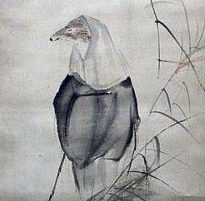
Ōtagaki Rengetsu (1791–1875) moved through her age like a quiet moon reflected on water, leaving ripples that touched faith, art, and the human spirit. Her life was shaped by Buddhist devotion and the vows of a nun, yet her influence radiated far beyond the cloister. She belonged to a rare constellation of creators whose spirituality flowed seamlessly into poetry, calligraphy, ink painting, and the humble beauty of pottery. In each medium, Rengetsu transformed simplicity into grace, allowing impermanence itself to become art.
The Met Museum reports, “Otagaki Rengetsu took vows as a Buddhist nun, but is better remembered as one of the foremost waka poets of the nineteenth century, an ink painter, a skilled calligrapher in a refreshingly simple and elegant style, and a prolific potter who inscribed poems into ceramic teaware …She married twice and had five children, but after the death of her second husband in 1823 and the tragic death of all her children she became a nun, taking the Buddhist sobriquet Rengetsu (“Lotus Moon”).”
Before leaving this world Rengetsu gracefully wrote:
My wish is to see
a cloudless moon
above the lotus flower
in my next life.

With quiet intensity, Sawako Utsumi fuses land and spirit, setting a wandering Buddhist monk against the vast stillness of Japan’s bleak midwinter. Snow-laden fields and muted skies do not merely frame the figure; they breathe with him, turning the landscape itself into a silent participant in his journey. The scene feels suspended in time, where footsteps echo not only across frozen earth, but through layers of memory, belief, and introspection.
Religion, in its many forms — Buddhism, Christianity, and Shintoism — surfaces repeatedly in Utsumi’s work, not as doctrine, but as presence. Faith appears as gesture, atmosphere, and quiet endurance, woven into the rhythms of human movement and the natural world. Her vision resists rigid boundaries, allowing spiritual traditions to converse rather than compete.
Nichiren (1222-1282) said, “To accept is easy; to continue is difficult. But Buddhahood lies in continuing faith.”
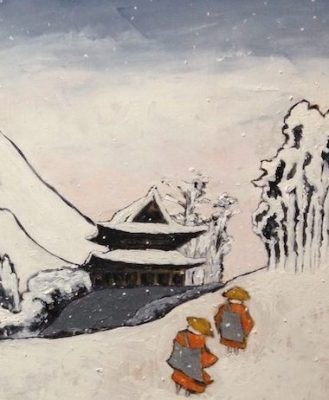
At the heart of her art lies a Shinto sensibility that is instinctive and undogmatic: a reverence for wind, snow, stone, and silence. Yet this openness does not exclude Buddhism. On the contrary, Utsumi’s landscapes gently honor the temples that punctuate Japan’s terrain, their weathered forms standing as companions to mountains and forests. In her work, belief is not imposed upon nature — it arises from it, as naturally as breath in cold air.
Accordingly, irrespective if these two Buddhist monks are returning home (art above by Utsumi) – or are on a religious pilgrimage – they accept all difficulties, without flinching from the right path.
The final art piece is also by Utsumi – where she enters the spiritual heart of Buddhism with a painter’s devotion, drawing deeply from the compassionate presence of Jizō (Ojizō-sama)—the guardian of travelers, the protector of children, and the gentle guide of wandering souls. In her hands, Jizō’s serenity is not merely depicted; it is invoked. Each brushstroke becomes a whispered prayer, a soft lantern illuminating the boundary between this world and the next.
Nichiren also pointedly said: “Life in this world is limited. Never be in the least bit afraid!”
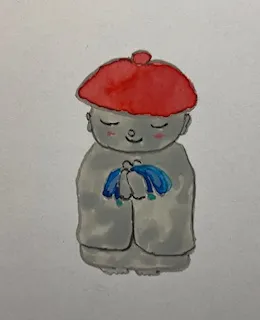
Through her art, the sacred and the intimate meet in quiet harmony—transforming the canvas into a place of reflection, solace, and spiritual embrace.
In my poem, I write:
All life diminishes in time.
Pain and fear soften into nothingness.
And nothingness becomes remembrance—held by only a few.
Yet even this remembrance drifts into dust,
for even the ghosts fade.
Each individual becomes less than a grain of sand,
and in the end, even the last trace is erased for eternity.
https://fineartamerica.com/featured/the-light-of-jizo-sawako-utsumi.html Buddhism and the Light of Jizo
https://fineartamerica.com/featured/japanese-buddhist-holy-men-in-the-deep-winter-sawako-utsumi.html Japanese Buddhist Holy Men in the Deep Winter
https://fineartamerica.com/featured/the-buddhist-lantern-of-life-and-jizo-sawako-utsumi.html The Buddhist Lantern of Life and Jizo
https://fineartamerica.com/featured/jizo-and-the-buddhist-lantern-of-life-sawako-utsumi.html Jizo and the Buddhist Lantern of Life
https://fineartamerica.com/featured/the-blossoming-of-life-before-the-leaves-fall-sawako-utsumi.html The Blossoming of Life before the Leaves Fall

Modern Tokyo News is part of the Modern Tokyo Times group
http://moderntokyotimes.com Modern Tokyo Times – International News and Japan News
http://sawakoart.com – Sawako Utsumi’s website and Modern Tokyo Times artist
https://moderntokyonews.com Modern Tokyo News – Tokyo News and International News
PLEASE JOIN ON TWITTER
https://twitter.com/MTT_News Modern Tokyo Times
PLEASE JOIN ON FACEBOOK