Japanese Art and Kaihō Yūshō (Buddhism and Culture)
Lee Jay Walker
Modern Tokyo Times
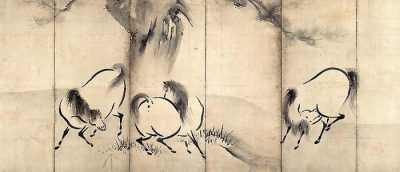
Buddhism profoundly shaped the inner life and artistic vision of the esteemed painter Kaihō Yūshō (1533–1615). A lay Buddhist priest, Yūshō moved through a rarefied cultural world where Zen practice, Chinese classics, garden aesthetics, Confucian ethics, poetry, literature, Shinto sensibilities, Taoist thought, and refined courtly culture quietly converged. Yet among these many influences, Buddhism remained the steady axis of his existence — informing not only his brush, but his understanding of impermanence, silence, and form.
To contemplate Yūshō’s paintings today — their mist-laden mountains, abbreviated ink gestures, and spacious voids — is to encounter a realm of meditative stillness. It is almost impossible to reconcile this serenity with the violent Sengoku landscape in which he lived. And yet this tension between spiritual refuge and historical upheaval defines his life. Yūshō was shaped by war as much as by Zen: his father perished when forces loyal to Oda Nobunaga attacked Odani Castle, a traumatic rupture that redirected the young boy toward monastic life.
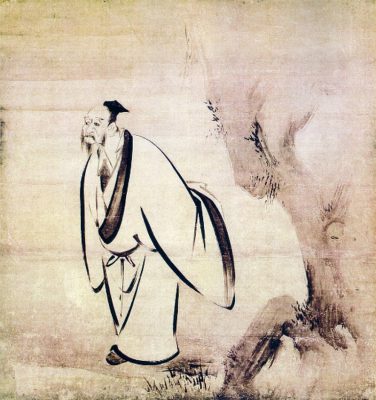
Sent to Tōfuku-ji in Kyoto as a novice, Yūshō found sanctuary within temple walls, where discipline, contemplation, and artistic study became intertwined. According to the MOA Museum of Art: “Kaihō Yūshō was born in Ōmi (present Shiga prefecture) as a son of a military commander who served Lord Asai Nagamasa. His father died in combat when Oda Nobunaga attacked Odani castle. Yūshō was unhurt since he was sent to Tōfuku-ji temple in Kyoto as a child novice. He first studied under Kanō Motonobu, became infatuated with the abbreviated brush technique of Liang Kai, and founded his original style of painting during the Momoyama period.”
This artistic lineage is telling. While trained in the formal Kanō tradition, Yūshō gravitated toward the expressive economy of Liang Kai, absorbing Chinese Chan aesthetics into a distinctly Japanese Zen idiom. His mature style balances structure and spontaneity — disciplined composition opening into sudden emptiness — echoing the Zen paradox itself.
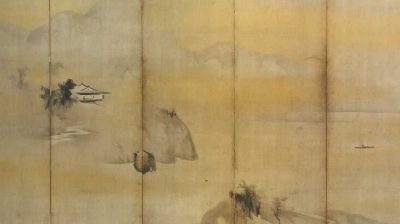
Yūshō lived through Japan’s great centralization, set in motion by Nobunaga and carried forward after his death, eventually culminating in the Edo Period of 1603. Thus, while Yūshō devoted himself to painting, Buddhism, and cultivated circles of high culture, he also bore witness to a society undergoing profound transformation. His art may appear timeless, but it emerged from an age of internal convulsion, political consolidation, and fragile peace.
The Saint Louis Art Museum beautifully captures the spiritual core of his work: “Kaihō Yūshō excelled in the painting tradition associated with Zen Buddhism in which the notion of emptiness is expressed in the tranquil disintegration of the physical world and the opening of a timeless and infinite void.”
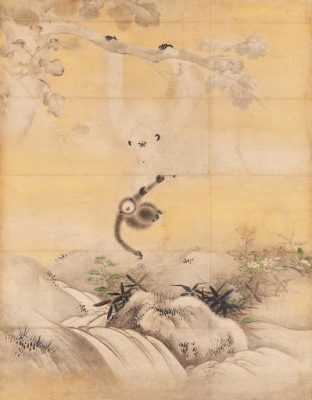
In Yūshō’s landscapes, we do not merely see mountains or clouds — we encounter ma, the breathing space between things; mu, the fertile emptiness; and a quiet invitation to step beyond surface appearances. His paintings become contemplative fields, where war-torn reality dissolves into ink and silence, and where Buddhism offers both solace and transcendence.
In this way, Kaihō Yūshō stands as a luminous cultural figure of Momoyama Japan — a painter-monk whose brush transformed personal loss and national upheaval into meditative beauty, leaving behind works that continue to whisper Zen across the centuries.

Modern Tokyo News is part of the Modern Tokyo Times group
http://moderntokyotimes.com Modern Tokyo Times – International News and Japan News
http://sawakoart.com – Sawako Utsumi personal website and Modern Tokyo Times artist
https://moderntokyonews.com Modern Tokyo News – Tokyo News and International News
PLEASE JOIN ON TWITTER
https://twitter.com/MTT_News Modern Tokyo Times
PLEASE JOIN ON FACEBOOK