
Japanese Art and Nature – Nishimura Goun
Lee Jay Walker
Modern Tokyo Times
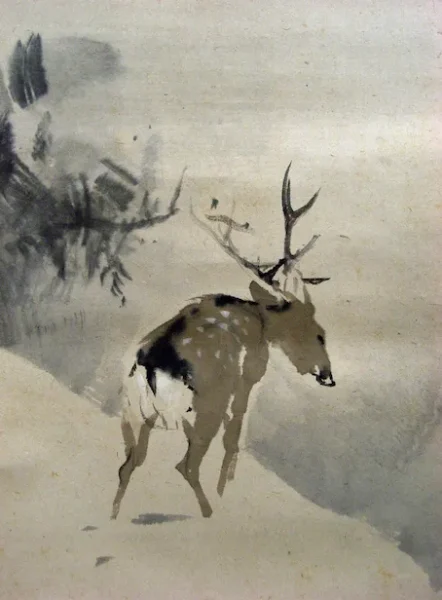
The Japanese artist Nishimura Goun (1877–1938) was born into the turbulent embrace of the Meiji Period (1868-1912), an age when Japan was being transformed with extraordinary speed. Industrialization gathered momentum, Western influences entered the cultural landscape, and ancient patterns of life encountered an unfamiliar modernity. Old and new collided like opposing currents.
Yet within Goun’s artistic world, particularly in these three exquisite depictions of animals, there is little sense of rupture. Instead, one encounters continuity, stillness, and an almost meditative intimacy with nature. His creatures seem to belong to an older Japan — a world where poetry, spirituality, seasonality, and observation were inseparable from artistic expression.
Born in Kyoto, the ancient heart of Japanese refinement, Goun inherited a cultural landscape shaped by centuries of artistic achievement stretching back through the Nara and Heian periods. His artistic formation within the Nihonga tradition placed him within a movement determined not simply to preserve classical Japanese painting, but to allow its spirit to breathe within a rapidly changing age.
That inheritance can be felt in the quiet architecture of his paintings: the delicate modulation of ink, the controlled elegance of the brush, the restrained use of color, and the careful placement of each living form. Nothing appears excessive. Nothing clamors for attention. Silence itself becomes part of the composition.
Goun’s animals possess this same quiet dignity. They are not merely observations from the natural world, nor decorative additions to an otherwise empty composition. They become vessels of meaning — creatures through which season, fragility, movement, solitude, and endurance enter the painting.
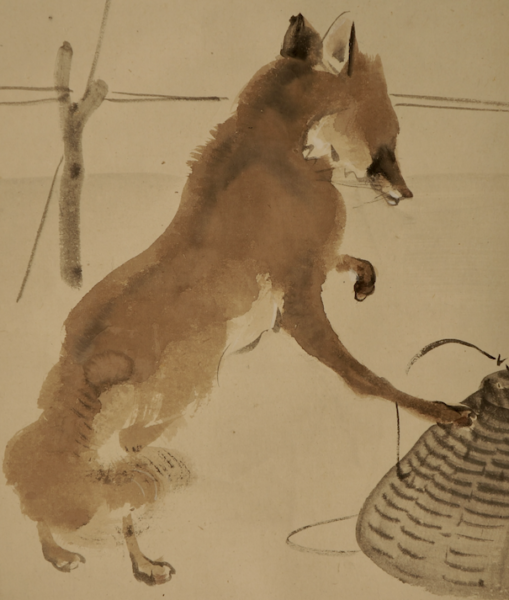
A feather, a curve of fur, a lowered head, or a moment of stillness can therefore carry an extraordinary emotional weight. Goun understood that nature does not always reveal its deepest truths through dramatic gestures. Sometimes, the smallest movement speaks most profoundly.
His animals consequently appear almost as emissaries from an older Japan. They evoke temple gardens beneath changing skies, classical poetry composed in contemplation of the seasons, quiet mountain paths, and the profound Japanese aesthetic awareness of impermanence. Their serenity is particularly poignant because Goun created these works while the world around him was being reshaped by forces that threatened to overwhelm precisely such forms of contemplation.
In this sense, his paintings offer more than beauty. They provide a sanctuary of continuity.
Goun was fortunate to study under Kishi Chikudō (1826–1897) and Takeuchi Seihō (1864–1942), two eminent masters whose accomplishments in animal painting profoundly influenced the development of modern Nihonga. From such teachers, Goun inherited not merely technical discipline but a particular way of looking at the natural world.
The lesson was profound: to paint an animal convincingly was not simply to reproduce its physical appearance. It was to understand its character, movement, vulnerability, and presence. Every feather and ripple of fur could become an expression of life itself.
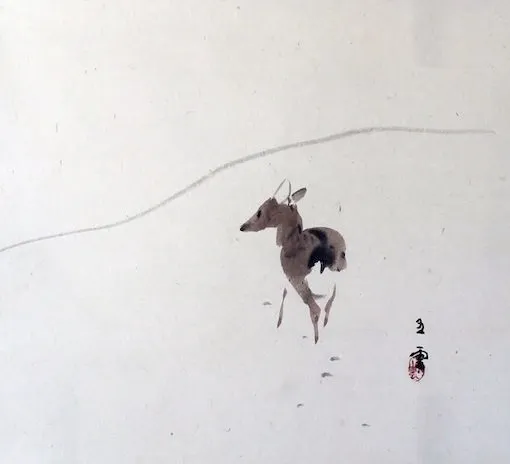
Goun thus emerged as a bridge between generations — carrying the refined observational traditions of classical Japanese painting into an age increasingly dominated by modern currents. His art reminds us that tradition need not remain frozen in the past. It can endure by changing quietly, carrying its deepest values forward without surrendering its soul.
Yet there was an unsettling fragility within Goun’s own life. From 1914 onward, persistent health problems increasingly restricted his ability to undertake large-scale works. The artist who had devoted himself to capturing the delicate vitality of nature was himself confronted by the limitations of the human body. Hence, there is something deeply moving in this parallel.
The animals within Goun’s paintings appear serene, but nature is never entirely free from vulnerability. Life is beautiful precisely because it is transient. In Goun’s later years, that truth was no longer merely an artistic observation; it had become part of his own existence. Nevertheless, his artistic spirit endured.
Goun’s legacy lies not in confrontation with modernity, but in quiet resistance to forgetfulness. At a moment when Japan was rushing toward a new future, he continued to listen to the older language of brush, ink, season, and living form. Therefore, his animals remain wonderfully still – and perhaps that is their greatest power.
Amid the machinery, uncertainty, and relentless transformation of modern Japan, they seem to whisper of another measure of time — the slower rhythm of nature, the memory of tradition, and the enduring beauty of a world that does not need to shout in order to be heard.
https://moderntokyonews.com/?s=Art Past articles about ART via MODERN TOKYO NEWS (Modern Tokyo Times group)
MODERN TOKYO TIMES – MODERN TOKYO NEWS – please check https://moderntokyonews.com
Please check Modern Tokyo News at https://moderntokyonews.com for articles going back over 12 years. Sadly, Modern Tokyo Times got hacked and lost 14 years of articles…

Modern Tokyo News is part of the Modern Tokyo Times group
http://moderntokyotimes.com Modern Tokyo Times – International News and Japan News
http://sawakoart.com – Sawako Utsumi’s website and Modern Tokyo Times artist
https://moderntokyonews.com Modern Tokyo News – Tokyo News and International News
PLEASE JOIN ON TWITTER
https://twitter.com/MTT_News Modern Tokyo Times
PLEASE JOIN ON FACEBOOK
https://www.facebook.com/moderntokyotimes