
Japan Art and Winter: Landscapes and Buddhism
Lee Jay Walker
Modern Tokyo Times
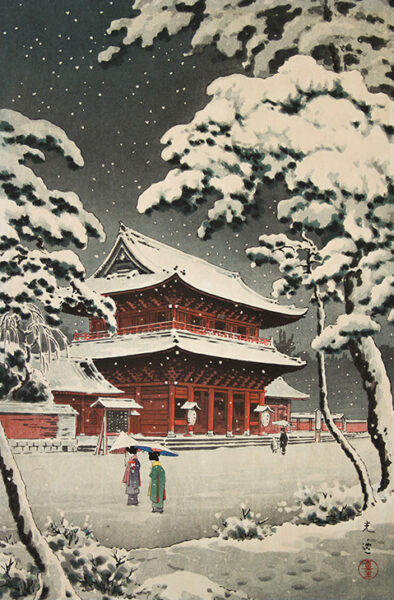
Tsuchiya Kōitsu was born during the early Meiji Period and died in 1949. Accordingly, his life and artistic development were shaped by the revolutionary Meiji Period (1868–1912), when Japan underwent profound transformations across its artistic, economic, military, social, and political landscapes. Amid these changes, traditional Japanese aesthetics continued to evolve, creating new opportunities for artists to reinterpret the beauty of their homeland.
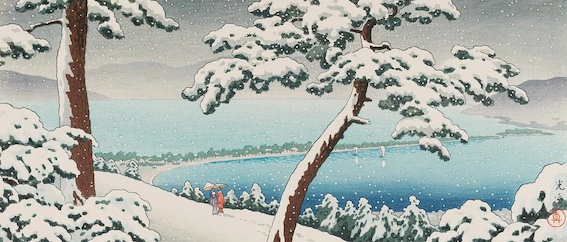
In this article, the focus is on the stunning winter scenes of Kōitsu. The delicate interplay between snow, light, and the surrounding landscape reveals his remarkable artistic sensitivity. Winter possesses a distinctive beauty in Japanese art, where the stillness of nature, the quiet atmosphere of snowfall, and the subtle variations of light can transform an ordinary landscape into something deeply evocative. Through his masterful approach, Kōitsu captures the serenity of winter while allowing the natural world to speak through its own understated elegance.
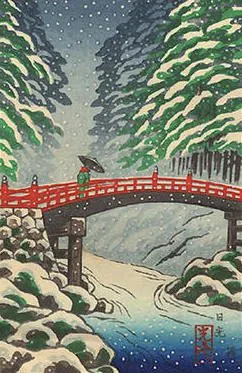
The second image, depicting the Sacred Bridge (Shinkyō Bridge), also provides a rich cultural and religious dimension. Located in Nikkō, this celebrated bridge belongs to a landscape where history, nature, Buddhism, and Shinto traditions converge. Its striking presence amid the surrounding natural beauty evokes the spiritual significance of this historic setting. Visitors traditionally cross the bridge area and continue towards the Buddhist temples and Shinto shrines that make Nikkō such an important centre of Japanese religious and cultural heritage. In a winter setting, the bridge takes on an especially contemplative quality, with the surrounding landscape enhancing the sense of reverence, tranquillity, and timelessness.
Kōitsu is remembered for his captivating landscapes, particularly his ability to portray snow, atmospheric conditions, and the changing qualities of light. His winter scenes are especially appealing because they convey more than the physical appearance of a place. Through subtle contrasts and carefully considered compositions, he captures the quiet poetry of nature, inviting the viewer to appreciate the beauty that emerges when the landscape rests beneath a blanket of snow. Where sacred architecture enters these scenes, the relationship between humanity, nature, and spiritual tradition becomes even more compelling.
The Koller Collection of Asian Art provides an important insight into the development of his career, stating: “He continued to produce lithographs until 1905, when he began to suffer from lung inflammation and work in the medium became potentially fatal. After abandoning lithography and working primarily in painting for nearly three decades, Kōitsu started designing more landscapes for woodblock prints (fukei-ga) in 1931. His return to printmaking is typically traced to the apocryphal meeting with esteemed print publisher Watanabe Shōzaburō (1885–1962) at a memorial exhibition commemorating Kiyochika.”
Kōitsu developed his artistic abilities under the acclaimed Kobayashi Kiyochika (1847–1915), with the two artists working together for nearly two decades. Kiyochika’s interest in light and atmospheric effects provided an important artistic context for Kōitsu’s own development. Kōitsu (influenced by Kiyochika) produced kōsen-ga (light-ray pictures) and became associated with shin-hanga, the new print movement that revitalised traditional Japanese woodblock printing through the collaboration of artists, carvers, printers, and publishers. His landscapes demonstrate how established Japanese artistic traditions could embrace new approaches to light, perspective, and atmosphere without losing their distinctive cultural identity.
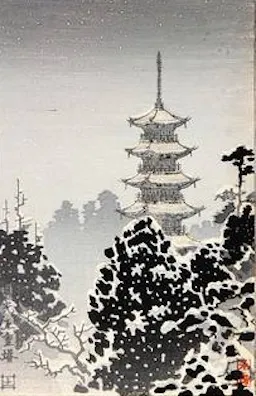
Through these remarkable winter scenes, Kōitsu invites us to appreciate the enduring relationship between artistic expression and the natural world. Snow softens the landscape, light gives it life, and sacred places remind us of the spiritual traditions woven into Japan’s cultural heritage.
https://moderntokyonews.com/?s=Art Past ART articles via MODERN TOKYO NEWS (Modern Tokyo Times group)
MODERN TOKYO TIMES – MODERN TOKYO NEWS – please check https://moderntokyonews.com
Please check Modern Tokyo News at https://moderntokyonews.com for articles going back over 12 years. Sadly, Modern Tokyo Times got hacked and lost 14 years of articles…

Modern Tokyo News is part of the Modern Tokyo Times group
http://moderntokyotimes.com Modern Tokyo Times – International News and Japan News
http://sawakoart.com – Sawako Utsumi and Modern Tokyo Times artist
https://moderntokyonews.com Modern Tokyo News – Tokyo News and International News
PLEASE JOIN ON FACEBOOK
https://www.facebook.com/moderntokyotimes