Japanese Art and the Maple Tree
Lee Jay Walker
Modern Tokyo Times
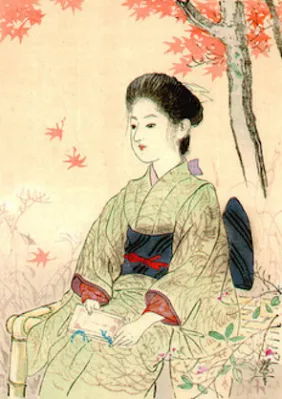
All three art pieces illuminate different emotional and seasonal dimensions of maple trees in Japan, revealing how autumn foliage can embody serenity, endurance, and joy through the imagination of distinct artistic minds.
The enchanting artwork by Tsukioka Kōgyo centers on a graceful young lady enjoying a moment of stillness beneath the radiant canopy of a red maple tree. The composition is imbued with quiet elegance, where the vivid crimson leaves appear to shelter her in a world detached from haste and noise. Kōgyo — who studied under Tsukioka Yoshitoshi and Ogata Gekkō — delicately captures the serene refinement of the woman while emphasizing the calming and almost meditative aura created by the maple tree itself. The scene evokes the gentle poetry of autumn in Japan, where nature and human emotion merge in silent harmony.
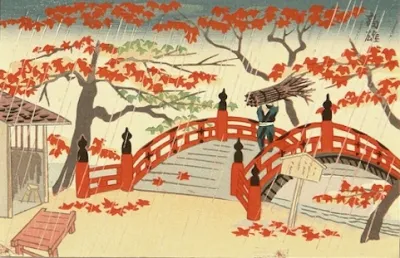
In striking contrast to this tranquility, the autumn scene by Tomikichiro Tokuriki conveys movement, hardship, and resilience. Wind and rain sweep across the landscape as a lone worker struggles against the elements, pressing onward despite the harsh weather. Yet amid the storm, the red maple trees and bridge still radiate an undeniable beauty, creating a dramatic tension between nature’s elegance and its unforgiving force. The work captures autumn not as a season of quiet reflection, but as one of perseverance and fleeting intensity.
The British Museum says: “In 1928 he studied ‘Nihonga’ painting under Tsuchida Bakusen (1887–1936) and Yamamoto Shunkyo (1871–1933) and exhibited with Kokuga Sosaku Kyokai, but about the same time in 1929 he changed to woodblock printing under the influence of Hiratsuka Un’ichi and began to contribute to the early print magazine ‘Han’…”
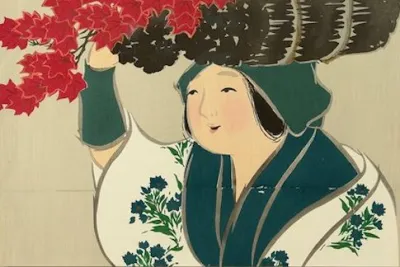
In the final two artworks, Kamisaka Sekka presents a joyful and uplifting vision of autumn. A cheerful-looking young lady carries brilliant red maple leaves in a basket, embodying warmth, vitality, and seasonal abundance. Unlike the contemplative stillness of Kōgyo or the elemental struggle depicted by Tokuriki, Sekka’s composition celebrates autumn with decorative vibrancy and human happiness (second art by Sekka focuses solely on nature). The flowing forms and elegant use of color reveal his mastery of blending classical Japanese aesthetics with modern artistic sensibilities.
The Panasonic Shiodome Museum of Art says: “Kamisaka Sekka (1866–1942) was an influential nihon-ga painter and designer in early 20th century Kyoto. Upon visiting Europe at the turn of the 20th century to study the latest movements in arts and crafts, Sekka began to see the beauty of traditional Japanese decorative arts in a new light. He both emulated the style of the 17th-century Rimpa school and fused classical and modern ideas and moved freely between the fields of fine art and design.”
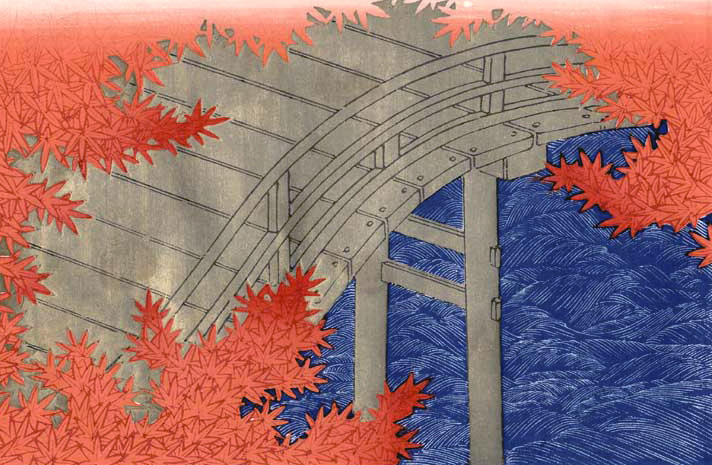
Together, these three works reveal the extraordinary symbolic power of maple trees in Japanese art. They become more than seasonal ornaments: they are mirrors of human feeling — capable of expressing serenity beneath crimson leaves, endurance amid autumn storms, and the radiant joy of carrying the colors of the season itself.
MODERN TOKYO TIMES – MODERN TOKYO NEWS – please check https://moderntokyonews.com
Please check Modern Tokyo News at https://moderntokyonews.com for articles going back over 10 years. Sadly, Modern Tokyo Times got hacked and lost 14 years of articles…

Modern Tokyo News is part of the Modern Tokyo Times group
http://moderntokyotimes.com Modern Tokyo Times – International News and Japan News
http://sawakoart.com – Sawako Utsumi and her website – Modern Tokyo Times artist
https://moderntokyonews.com Modern Tokyo News – Tokyo News and International News
PLEASE JOIN ON TWITTER
https://twitter.com/MTT_News Modern Tokyo Times
PLEASE JOIN ON FACEBOOK