Japanese Culture and Female Warrior of Twelfth-Century (Tomoe Gozen)
Lee Jay Walker
Modern Tokyo Times
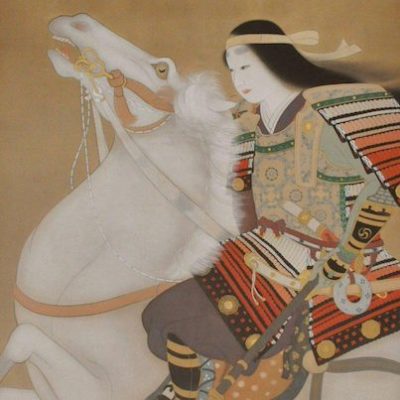
Tomoe Gozen stands as one of the most celebrated female warriors of twelfth-century Japan, a figure rooted in the turbulent final decades of the Heian period (794–1185). This was an age marked by the gradual erosion of courtly aristocratic power and the decisive rise of the warrior class, a transformation that culminated in the Genpei War (1180–1185) between the rival Taira and Minamoto clans.
Within this shifting political and social landscape, women of the warrior elite were not merely passive observers. Female warriors—most notably Tomoe Gozen and Lady Hangaku Gozen—were admired for their martial skill, courage, and loyalty. Their presence on the battlefield reflected older traditions in which women of bushi families were expected to defend estates, command troops when necessary, and preserve clan honor during times of crisis.
Japanese literature and oral tradition preserved Tomoe’s legacy with particular care. She appears most famously in The Tale of the Heike, where she is depicted as both a formidable fighter and a paragon of loyalty and beauty. These literary portrayals ensured that her memory endured long after the collapse of the Heian order, allowing later generations to reimagine her role within Japan’s warrior past.
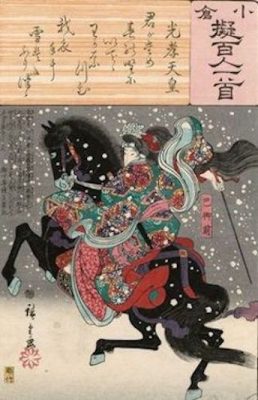
With the emergence of ukiyo-e printmaking during the Edo period (1603–1868), artists found renewed inspiration in legendary warriors—both male and female—from earlier centuries. Edo audiences, living in an era of relative peace under Tokugawa rule, looked back to the violence and heroism of the medieval age with fascination and nostalgia. As a result, figures like Tomoe Gozen were visually reconnected to Japan’s martial heritage through woodblock prints, theater, and popular literature.
The Toshidama Gallery observes: “Prior to the late Edo period it was common for women to fight alongside men in battle and in the defence of communities. This role is greatly at odds with contemporary positions of women in Japanese society and does not chime with Western ideas of compliant Japanese females.”
The prints referenced here—by Miki Suizan, Andō Hiroshige, and Tsukioka Yoshitoshi—each reflect Edo-period interpretations of this earlier world. Hiroshige’s work is particularly evocative, incorporating a poem by Emperor Kōkō (Tennō Kōkō), thereby linking martial imagery with classical literary tradition and imperial culture.
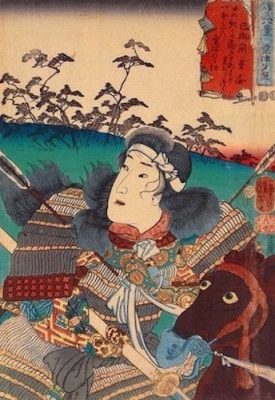
Historically, female warriors were trained in multiple aspects of clan warfare. Weapons were selected with careful attention to physique, height, strength, and speed. The naginata was especially favored for its reach and adaptability, while the kaiken served both defensive and ritual purposes. Training often included tantojutsu—the art of knife fighting—alongside broader skills necessary for survival, leadership, and defense during siege or retreat.
Above all, Tomoe Gozen is remembered for her unwavering loyalty to Minamoto no Yoshinaka (1154–1184), one of the central figures of the Genpei War. Her devotion to Yoshinaka, even as his fortunes declined, has ensured her place not only in history, but in the enduring imagination of Japan’s warrior tradition.

Modern Tokyo News is part of the Modern Tokyo Times group
http://moderntokyotimes.com Modern Tokyo Times – International News and Japan News
http://sawakoart.com – Sawako Utsumi’s website and Modern Tokyo Times artist
https://moderntokyonews.com Modern Tokyo News – Tokyo News and International News
PLEASE JOIN ON TWITTER
https://twitter.com/MTT_News Modern Tokyo Times
PLEASE JOIN ON FACEBOOK