
Japan Art and Okuyama Gihachiro (World of Black and White)
Lee Jay Walker
Modern Tokyo Times
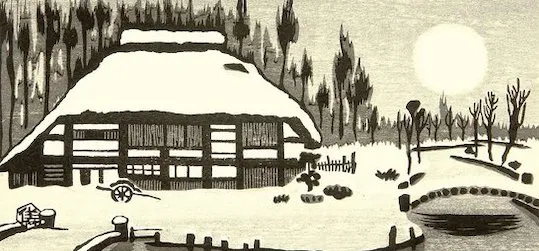
Okuyama Gihachiro (1907–1981) created a distinctive world where black and white became far more than opposing shades. Through his artistic vision, snow-covered landscapes, quiet villages, winter trees, animals, moonlit scenes, and the rhythms of everyday Japanese life were transformed into compositions possessing an almost dreamlike simplicity. His prints demonstrate how restraint can itself become powerful, allowing silence, atmosphere, and nature to speak through the spaces between the dark and light.
Born in Yamagata Prefecture, Okuyama studied under Kosaka Gajin, absorbing artistic traditions that would later contribute to his own distinctive direction. During the 1920s, he initially worked in poster design and other commercial artistic fields before establishing his own business in advertising. Yet, beneath these commercial pursuits, his fascination with design, composition, and the visual language of Japanese life continued to develop.
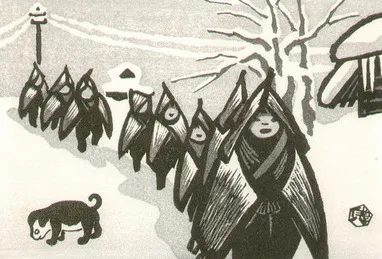
Okuyama produced a remarkable number of prints and designs throughout his long career. His journey also reflected the turbulence of twentieth-century Japan, as the economic difficulties of the late 1920s and early 1930s were followed by the profound disruptions of the war years. Nevertheless, he endured these difficult periods and found increasing opportunities in the post-war era, when Japanese printmaking was once again able to reach wider audiences both domestically and internationally.
There is something especially captivating about Okuyama’s winter imagery. Snow does not merely cover the landscape; it transforms it. A farmhouse beneath a heavy white blanket, distant trees standing quietly against the sky, or a small animal moving through the cold suddenly becomes part of a larger meditation on solitude, nature, and the passage of time. His limited palette intensifies this feeling, with black providing structure while white creates an almost spiritual spaciousness.
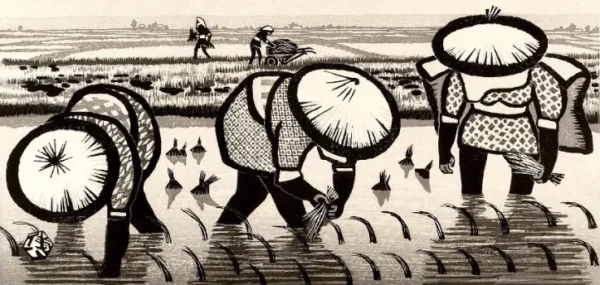
In this respect, Okuyama Gihachiro’s art possesses a quiet poetry. He did not need an abundance of colour to capture the beauty of Japan. Instead, through black, white, line, snow, shadow, and silence, he revealed another Japan—one of secluded villages, changing seasons, humble surroundings, and nature existing in delicate harmony with human life.
Ultimately, Okuyama Gihachiro remains a fascinating figure in twentieth-century Japanese art. His work reminds us that artistic beauty does not always require brilliance or excess. Sometimes, the deepest impression comes from simplicity: a winter moon, a snow-covered roof, a bare tree, or footsteps disappearing into the quiet landscape. In such moments, black and white cease to be merely colours and become a language of memory, atmosphere, and Japanese cultural beauty.
https://moderntokyonews.com/?s=Art Past articles about ART via MODERN TOKYO NEWS (Modern Tokyo Times group)
MODERN TOKYO TIMES – MODERN TOKYO NEWS – please check https://moderntokyonews.com
Please check Modern Tokyo News at https://moderntokyonews.com for articles going back over 12 years. Sadly, Modern Tokyo Times got hacked and lost 14 years of articles…

Modern Tokyo News is part of the Modern Tokyo Times group
http://moderntokyotimes.com Modern Tokyo Times – International News and Japan News
http://sawakoart.com – Sawako Utsumi’s website and Modern Tokyo Times artist
https://moderntokyonews.com Modern Tokyo News – Tokyo News and International News
PLEASE JOIN ON FACEBOOK
http://facebook.com/moderntokyotimes