
Japan Art and Winter (Landscapes and Nature)
Lee Jay Walker
Modern Tokyo Times
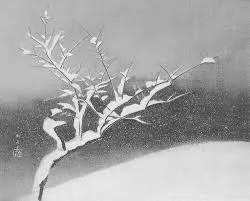
The artist Gyoshū Hayami (1894–1935) produced remarkable art throughout his relatively brief life. His work seamlessly blended traditional Japanese styles—such as Bunjinga, Rinpa (Rimpa), and Yamato-e—with elements of European art, including influences from the Northern Renaissance and Symbolism.
As a young artist, Gyoshū was also deeply inspired by Chinese art, particularly from the Song and Yuan dynasties. These traditions, closely connected to Japan’s Bunjinga style, had a profound impact on his artistic development.
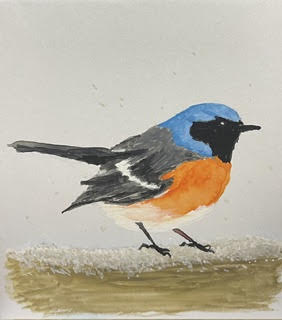
Sawako Utsumi, a contemporary artist who hails from northern Japan, depicts the Redstart above in a mild winter scene. Accordingly, the Redstart is perched on a snow-covered log but appears seemingly at peace. Similar to Robins in the United Kingdom, the Redstart in low-level mountain areas is extremely inquisitive and friendly.
Each year, in Utsumi’s mountain abode – where small Shinto shrines and Buddhist temples dot the landscape (even if Shinto shrines are often small in scale) – the Redstart, despite not having the spiritual association of Jizō, still provides a warmth inside.
The poet Iida Dakotsu (1885-1962) wrote:
In the timber forest,
past the little redstart—
a drift of woodsmoke.
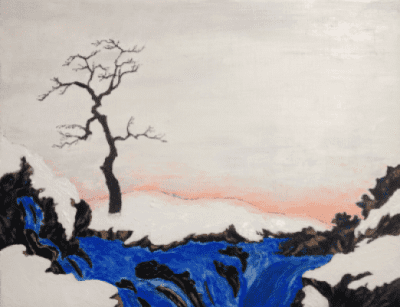
In the work shown above, Utsumi bows respectfully toward the great rinpa master Suzuki Kiitsu (1796–1858). Yet this is not imitation—it is dialogue across centuries. Where Kiitsu’s original composition flows with the warmth and rhythm of summer drifting into autumn, Utsumi deliberately cools the scene, tilting both season and perspective. The gentle passage of time in Kiitsu’s vision is transformed into the stark hush of winter.
The final art piece is by Nishimura Goun (1877–1938). He was born into the turbulent embrace of the Meiji Period (1868-1912), an age when Japan was being transformed with extraordinary speed. Despite the turbulence, Goun was fortunate to study under Kishi Chikudō (1826–1897) and Takeuchi Seihō (1864–1942), two eminent masters whose accomplishments in animal painting profoundly influenced the development of modern Nihonga. From such teachers, Goun inherited not merely technical discipline but a particular way of looking at the natural world.
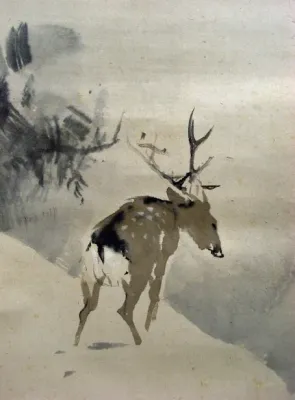
The lesson was profound: to paint an animal convincingly was not simply to reproduce its physical appearance. It was to understand its character, movement, vulnerability, and presence. Every feather and ripple of fur could become an expression of life itself.
https://fineartamerica.com/featured/bleak-midwinter-and-the-buddhist-tree-of-life-sawako-utsumi.html
https://fineartamerica.com/featured/1-redstart-in-winter-sawako-utsumi.html?newartwork=true
https://moderntokyonews.com/?s=Art Past ART articles via MODERN TOKYO NEWS (Modern Tokyo Times group)
MODERN TOKYO TIMES – MODERN TOKYO NEWS – please check https://moderntokyonews.com
Please check Modern Tokyo News at https://moderntokyonews.com for articles going back over 12 years. Sadly, Modern Tokyo Times got hacked and lost 14 years of articles…

Modern Tokyo News is part of the Modern Tokyo Times group
http://moderntokyotimes.com Modern Tokyo Times – International News and Japan News
http://sawakoart.com – Sawako Utsumi and Modern Tokyo Times artist
https://moderntokyonews.com Modern Tokyo News – Tokyo News and International News
PLEASE JOIN ON FACEBOOK
https://www.facebook.com/moderntokyotimes