
Japan Art – Edo, Meiji, and Contemporary Japanese Art
Lee Jay Walker
Modern Tokyo Times
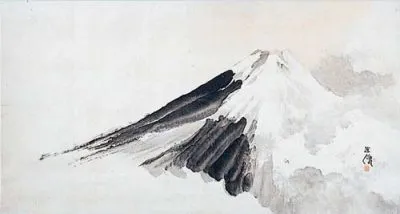
Kubota Beisen (1852–1906) was born during the final years of the Edo Period, standing at a fascinating cultural crossroads between an age of shogunal rule and the extraordinary transformation that followed the Meiji Restoration. His formative years were therefore steeped in the visual and cultural traditions of Edo Japan, even as the rapidly changing Meiji Period (1868–1912) would reshape the artistic world around him.
Beisen began his artistic training under Suzuki Hyakunen (1825–1891), although his father, an innkeeper, initially opposed his decision to pursue a life devoted to art. Yet artistic vocation proved stronger than parental resistance. Although he received guidance from both Suzuki Hyakunen and Kōno Bairei (1844–1895), Beisen remained, in significant measure, self-taught. This independence is important when considering his place within an era when Japanese artists were increasingly negotiating between inherited traditions and the pressures of a rapidly modernizing nation.
His art belongs to a generation that witnessed Japan’s dramatic passage from the cultural world of Edo into the new realities of Meiji. Mountains, landscapes, birds, flowers, and other manifestations of nature retained profound importance within Japanese painting, but their meanings could be reconsidered as artists encountered new techniques, institutions, and ideas. In this sense, Beisen represents more than a painter caught between two historical periods: he embodies an important cultural continuity, carrying elements of Japan’s older artistic sensibility into a new age.
Hishida Shunsō (1874–1911), meanwhile, emerged from the very heart of the Meiji transformation. Born in Nagano Prefecture in 1874, he belonged to a generation raised within a Japan increasingly conscious of the outside world, yet deeply engaged in preserving and reinventing its own cultural identity.
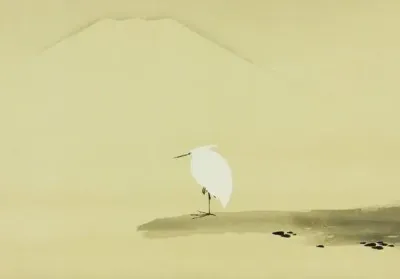
Shunsō moved to Tokyo in 1889, leaving behind the quieter landscapes of Nagano for a capital undergoing extraordinary change. Tokyo was becoming the centre of Japan’s modern political, intellectual, and artistic life. For a young artist, the transition must have been profound: the rhythms of rural Japan were replaced by an urban environment where Western artistic ideas encountered centuries-old Japanese traditions.
This tension between tradition and modernity became one of the defining questions of Meiji art. Shunsō would become associated with the development of Nihonga, a modern movement that sought not simply to imitate the West but to renew Japanese painting through traditional materials, techniques, aesthetics, and sensibilities. His work consequently belongs to that fascinating cultural conversation in which Japanese artists asked how their artistic heritage could remain alive in a rapidly changing world.
There is particular poignancy in Shunsō’s short life. He died in 1911, only months before his 37th birthday, and therefore never witnessed the conclusion of the Meiji Period in 1912. Yet his artistic legacy extended far beyond the brevity of his years. His delicate treatment of atmosphere, nature, and suggestion helped demonstrate that Japanese painting could evolve without surrendering its distinctive identity.
In this respect, Kubota Beisen and Hishida Shunsō can be viewed as two different expressions of the same cultural journey. Beisen was born in the closing years of Edo and carried that world’s artistic inheritance into Meiji Japan. Shunsō was born into Meiji itself and participated in the search for a renewed Japanese artistic language. Both, in their different ways, reveal how Japanese art did not simply abandon the past when modernity arrived — it reinterpreted the past.
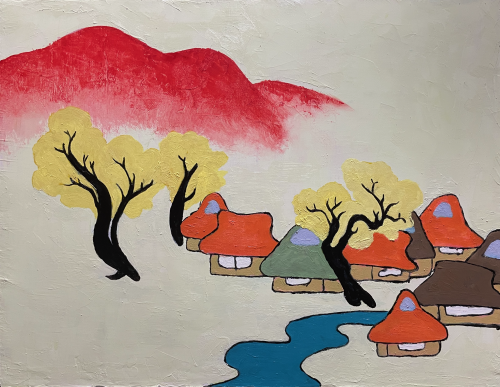
That cultural dialogue continues into the contemporary age through artists such as Sawako Utsumi, whose work demonstrates that Japanese artistic inspiration can remain deeply connected to earlier traditions while speaking in a distinctly modern voice.
Utsumi holds a profound reverence for Kamisaka Sekka (1866–1942), one of the great figures associated with the revitalization of Japanese decorative art. Sekka’s sophisticated relationship with the Rinpa tradition, with its emphasis on rhythm, stylization, decorative beauty, nature, and harmonious composition, provides an important point of reference. Yet Utsumi does not merely reproduce the past. Instead, she transforms its spirit through a contemporary imagination and a palette that is unmistakably her own.
Her enchanting village seems to exist somewhere between Japanese folk memory, seasonal landscape, and the dream world of childhood. The rounded forms, vivid colours, stylized trees, flowing water, and distinctive houses create an almost mythical landscape — one that feels familiar and fantastical at the same time.
There is also something deeply Japanese in this willingness to allow the natural and imaginary worlds to coexist. The landscape is not merely a backdrop. The mountains, trees, water, colours, and settlements become part of a poetic environment in which human life and nature appear gently intertwined. Such sensitivity resonates with the long Japanese tradition of finding beauty in the changing seasons and in the intimate relationship between humanity and the natural world.
Utsumi’s work therefore offers a charming contemporary continuation of a much older artistic conversation. From Beisen’s passage from Edo into Meiji, through Shunsō’s search for a renewed Japanese painting, to Utsumi’s imaginative dialogue with Sekka, the thread is not one of simple imitation but of cultural renewal.
Japanese art has repeatedly demonstrated this remarkable ability: to absorb change without losing its soul, to honour tradition without becoming imprisoned by it, and to transform inherited beauty into something newly alive.
https://moderntokyonews.com/?s=Art Past articles about ART via MODERN TOKYO NEWS (Modern Tokyo Times group)
MODERN TOKYO TIMES – MODERN TOKYO NEWS – please check https://moderntokyonews.com
Please check Modern Tokyo News at https://moderntokyonews.com for articles going back over 12 years. Sadly, Modern Tokyo Times got hacked and lost 14 years of articles…
https://fineartamerica.com/featured/the-magical-mountain-village-inspired-by-sekka-sawako-utsumi.html Mountain Village by Sawako Utsumi (Homage to Kamisaka Sekka)
http://fineartamerica.com/profiles/sawako-utsumi.html Sawako Utsumi and where you can buy her art, postcards, bags, and other products. Also, individuals can contact her for individual requests.

Modern Tokyo News is part of the Modern Tokyo Times group
http://moderntokyotimes.com Modern Tokyo Times – International News and Japan News
http://sawakoart.com – Sawako Utsumi’s website and Modern Tokyo Times artist
https://moderntokyonews.com Modern Tokyo News – Tokyo News and International News
PLEASE JOIN ON TWITTER
https://twitter.com/MTT_News Modern Tokyo Times
PLEASE JOIN ON FACEBOOK
https://www.facebook.com/moderntokyotimes