Japanese Art and Deer: Invisible Shinto Kami and Buddhism
Lee Jay Walker
Modern Tokyo Times
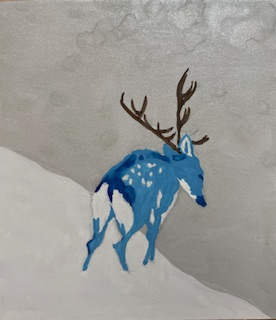
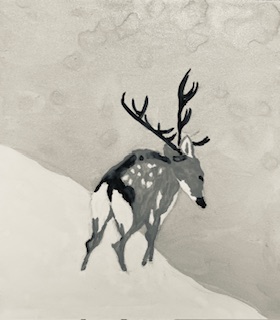
Sawako Utsumi, a contemporary artist shaped by the hushed landscapes of northern Japan, summons the deer not merely as form, but as presence. In her hands, color loosens its earthly weight and drifts toward the ineffable, becoming a muted hymn to what cannot be named. The deer glimmers in suspension, poised between breath and stillness, its body a vessel for unseen currents.
Within Shinto thought, the deer has long walked as a messenger of the Kami, a living threshold between the mundane and the sacred. Utsumi honors this ancient role without proclamation. Her deer does not declare divinity; it listens for it. The figures in various art pieces seem to emerge from silence itself, as though the forest and landscapes had briefly chosen to remember its soul.
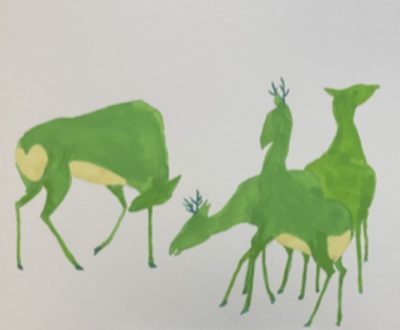
Her palette hums with restraint and devotion — pigments softened, edges dissolving, light resting gently rather than illuminating. The sacred is never grasped outright. Instead, it lingers like mist at dawn, sensed rather than seen. One feels that the Kami have passed nearby, leaving only the faintest trace of their movement.
In these works, the spiritual essence of the deer is not illustrated; it is inhabited. It dwells in the pause between colors, in the breath held by the viewer, in the quiet awareness that something ancient and tender stands before us — not asking to be understood, only to be felt.
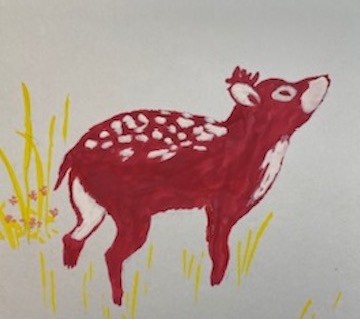
The BBC says, “Kami are not inherently different in kind from human beings or nature – they are just a higher manifestation of the life energy… an extraordinary or awesome version… Kami don’t exist in a supernatural universe – they live in the same world as human beings and the world of nature.”
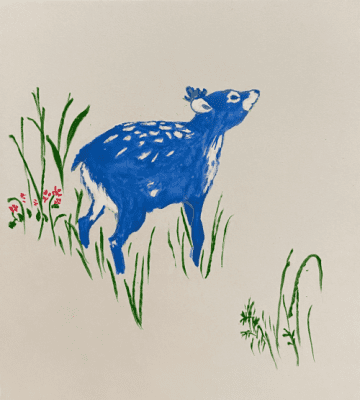
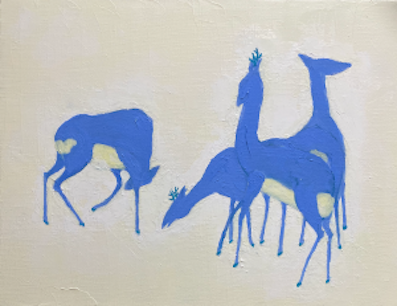
In the second and sixth art pieces, Utsumi bows gently toward Nakamura Hōchū, drawing from his Edo Period visions of the deer — creatures rendered with elegance, restraint, and rhythmic grace. Yet her homage is not an echo. It is a transformation. Where Hōchū’s palette spoke in measured tones, Utsumi releases color into bold, resonant fields, allowing chromatic intensity to carry the weight of a contemporary philosophical gaze.
Her reimagining is shaped by a Buddhist sensibility concerning the four deer (not the single entity of one deer and the Shinto angle), though it does not announce itself through iconography or doctrine. Instead, it unfolds as thought made visible. The presence of four deer becomes a contemplative device — a quiet meditation on the four winds of Buddhism. These winds, in Utsumi’s understanding, signify the opposing currents that shape every human life: gain and loss, praise and blame, joy and sorrow — forces that arrive without invitation and depart without certainty.
The deer stand not as symbols frozen in time, but as witnesses to inevitability. They move through the painting as life itself moves through us — encountering resistance, harmony, rupture, and renewal. To reach a certain age, Utsumi suggests, is to feel these winds upon one’s own body and spirit, to recognize their power, and to seek balance rather than escape.
Thus, the work becomes more than homage or reinterpretation. It is a reflection on impermanence, resilience, and quiet acceptance. Between Edo memory and contemporary insight, between Shinto reverence and Buddhist reflection, Utsumi allows the deer to carry what words cannot — the knowledge that transformation is not an interruption of life, but its most faithful companion.
OVERALL
In Utsumi’s hands, the spiritual essence of the deer is never shown; it is received. It passes quietly through the twin prisms of Buddhism and Shinto, refracted into sensation rather than symbol. The sacred does not stand in the foreground of the image — it breathes within it.
It lingers in the pauses between colors, where pigment hesitates and meaning gathers. It dwells in the generous space surrounding the form, where absence becomes as eloquent as presence. The deer seems less painted than listened to, as though the artist has allowed the canvas to remember something older than vision.
Across the surface of the work, an atmosphere settles — hushed, attentive, devotional. Shinto’s nearness of the Kami (single deer) and Buddhism’s awareness of impermanence do not compete (four deer); they coalesce into a single, quiet awareness. Nothing is announced. Nothing is explained.
What emerges is a vision of the sacred as abiding rather than asserted — a subtle radiance held just beneath the surface, like a prayer never spoken aloud, yet endlessly resonant.
https://fineartamerica.com/featured/sacred-deer-in-winter-sawako-utsumi.html Sacred Deer in Winter
https://fineartamerica.com/featured/the-spirit-of-the-deer-sawako-utsumi.html The Spirit of the Deer
https://fineartamerica.com/featured/four-winds-of-buddhism-and-deer-sawako-utsumi.html Buddhism and the Deer
https://fineartamerica.com/featured/stillness-of-the-night-utsumi-and-homage-to-hagiwara-hideo-sawako-utsumi.html?newartwork=true Stillness of the Night by Sawako Utsumi
https://fineartamerica.com/featured/deer-and-the-sacred-kami-sawako-utsumi.html?newartwork=true Deer and the Sacred Kami
https://fineartamerica.com/featured/shinto-and-the-shadow-of-the-past-illuminated-sawako-utsumi.html?newartwork=true Shinto and the Shadow of the Past Illuminated

Modern Tokyo News is part of the Modern Tokyo Times group
http://moderntokyotimes.com Modern Tokyo Times – International News and Japan News
http://sawakoart.com – Sawako Utsumi’s website and Modern Tokyo Times artist
https://moderntokyonews.com Modern Tokyo News – Tokyo News and International News
PLEASE JOIN ON TWITTER
https://twitter.com/MTT_News Modern Tokyo Times
PLEASE JOIN ON FACEBOOK