Japanese Novelist and Futabatei Shimei (1864-1909): Enthralled by Russia
Lee Jay Walker
Modern Tokyo Times

The Japanese novelist Futabatei Shimei (1864–1909) was born into the restless tides of the Meiji Period (1868–1912), an era that cracked open Japan’s ancient shell and exposed it to both light and fire. The age was revolutionary in spirit and violent in consequence: regional wars and rising nationalism collided with the sudden influx of Western ideas, while a brutal anti-Buddhist fervor swept across the land, reducing countless temples to ash and memory.
Yet for artists, writers, and seekers of meaning, Meiji Japan was also an age of rare possibility. Borders became permeable, minds grew restless, and distant worlds beckoned. Intellectuals traveled abroad, absorbed foreign literatures, and studied unfamiliar artistic traditions. For Futabatei, it was Russia — vast, multi-ethnic, and layered with spiritual and ideological contradictions — that illuminated both his literary vision and his social conscience.
His novel Ukigumo (The Drifting Cloud) is widely acclaimed as Japan’s first modern novel. Within its pages, the psychological depths of four characters unfold with quiet intensity. Ideas of freedom, individual will, and moral uncertainty drift through the narrative like clouds across an unsettled sky, compressed into a fleeting span of time yet rich with inner conflict.
Futabatei’s mastery of the Russian language opened a gateway to a profound literary inheritance. He translated — with varying degrees of fidelity and interpretation — the works of Andreyev, Garshin, Gorky, Tolstoy, Turgenev, and others, allowing their voices to echo within the evolving landscape of Japanese letters. During his formative years in the 1880s, he immersed himself especially in Belinsky, Dostoyevsky, Goncharov, and Turgenev, absorbing their moral seriousness, psychological nuance, and deep concern for the human condition.
The Russo-Japanese War (1904–05) cast a long shadow over his life and beliefs. In his youth, Futabatei had been stirred by nationalism and even aspired to military service, though he failed the entrance examination three times.
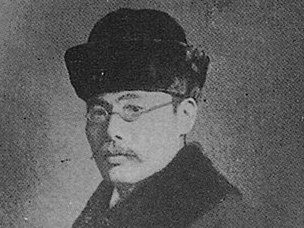
Yet the Russian writers he revered were often anti-war, reformist, and profoundly humanist. Their influence sharpened the duality within him — a tension between patriotic impulse and a growing awareness of suffering, conscience, and shared humanity that transcended national borders.
Futabatei is also remembered for one of literature’s most delicate gestures of love. Rather than translating “I love you” directly, he rendered it as, “The moon is beautiful, isn’t it?” — a phrase that carries an unspoken confession so complete that the response implies, “I can die happy.”
In this restraint lies both romance and cultural depth, where emotion glows quietly rather than declaring itself aloud.
The life of Futabatei Shimei — marked by literary innovation, early nationalism, unrealized military ambition, the trauma of war, and a deep engagement with foreign thought — reveals a man of complexity and contradiction, drifting between worlds much like the cloud he immortalized in his greatest work.
He passed away in 1909 from tuberculosis, leaving behind a legacy that continues to hover over modern Japanese literature — subtle, introspective, and quietly transformative.

Modern Tokyo News is part of the Modern Tokyo Times group
http://moderntokyotimes.com Modern Tokyo Times – International News and Japan News
http://sawakoart.com – Sawako Utsumi’s website and Modern Tokyo Times artist
https://moderntokyonews.com Modern Tokyo News – Tokyo News and International News
PLEASE JOIN ON TWITTER
https://twitter.com/MTT_News Modern Tokyo Times
PLEASE JOIN ON FACEBOOK