

Christian Church Funeral Attack in Jordan Kills 7 (Suspected Islamists)
Murad Makhmudov, Michiyo Tanabe, and Hiroshi Saito
Modern Tokyo Times
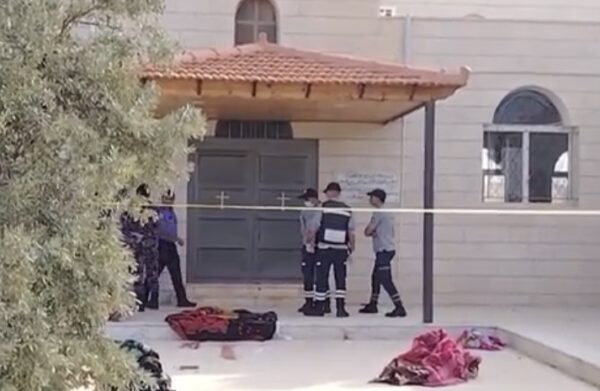
Suspected Islamists have killed at least seven mourners in a terrorist attack against a Greek Orthodox Christian church in Jordan. At least 34 people were also injured after the attackers reportedly opened fire on people inside the church compound in Hmoud (Hamoud), in the Karak region. The attack represents a horrific assault on innocent civilians and a direct challenge to the religious coexistence and national unity that Jordan seeks to preserve.
Mazen al-Faraya, the Interior Minister, denounced the terrorist attack and notified the media that security forces would seek out the “group of extremists.”
Al-Faraya described the terrorist incident as “painful and horrific” and “unparalleled in the history of the Hashemite Kingdom of Jordan.” His remarks underline the gravity of an attack that has shocked the country and struck at the heart of a Christian community gathering in a place of worship.
The BBC reports, “There was a heavy security presence at the entrance to a hospital treating people injured in the incident in Karak, amid an atmosphere charged with anger among residents of the governorate, particularly the families of those injured and killed.”
The National (UAE) reports, “Between 150 and 200 people were in and around the church at the time, the witness said, adding that most of the victims were aged between 50 and 70.”
King Abdullah II immediately visited the hospital to console the injured and express his concern for those affected by the carnage. Crucially, his response also reaffirmed his commitment to all Jordanians, irrespective of their religious beliefs. While local communities understandably remain in shock and mourning, the King’s personal intervention carries considerable significance. It demonstrates that the suffering of Jordan’s Christian minority is a national concern, rather than an issue confined to one religious community.
King Abdullah II declared that the security apparatus would “confront the terrorist act that targeted Karak with the harshest penalties”.
The King pointedly said: “The terrorist attack against Karak will be met with the harshest retaliation… Those who delude themselves into thinking that they can divide Jordanians with their bullets have no chance in the face of our unity. All Jordanians, from north to south, are partners in land and fate, and nothing stands between them.”
The King continued: “Every Jordanian life is precious, and we will strike with an iron fist against those who dare to threaten our nation.”
These words reflect the central challenge facing Jordan: preventing extremists from turning religious differences into instruments of hatred, fear and political destabilisation. The King’s emphasis on shared citizenship and a common national destiny is particularly important in a Middle East where sectarian divisions have fuelled persecution, displacement and prolonged conflict. Jordan’s stability cannot be taken for granted, but its commitment to national cohesion remains an important counterweight to the forces seeking to fracture the region.
Maj Gen Al Maaytah stated strongly: “Jordanians reject this cowardly terrorist act. It will strengthen the country’s push to combat terrorism in all its forms.”
He continued: “Jordan is immune to all attempts to drag it towards extremism and terrorism.”
Unlike several countries across the region, including Iraq and Syria, where sectarian violence and political fragmentation have inflicted enormous suffering, Jordan has maintained comparative stability. The continuing crisis involving Israel and Hamas in Gaza and the conflict in Yemen further illustrate the volatility of the wider Middle East. Jordan has experienced terrorist attacks and faces its own internal and external pressures; nevertheless, its relative calm stands in stark contrast to the devastation witnessed elsewhere.
Iranian strikes against American bases in Jordan, alongside attacks affecting other countries during the continuing confrontation between the United States and Iran, illustrate the kingdom’s exposure to wider geopolitical tensions. Jordan must navigate these dangers while protecting its sovereignty and domestic stability. Against this background, the threat posed by Sunni Islamist extremism must not be overlooked. The attack against the Greek Orthodox Christian community demonstrates that Jordan, despite its comparative stability, is not immune to the violence that has blighted neighbouring nations.
Lee Jay Walker, a Modern Tokyo Times analyst, says, “In neighboring Iraq you have sectarian attacks between the Shia and Sunni and ISIS still holds many Yazidi slaves. Also, other embattled minorities including Christians and Shabaks fear for their respective futures. Similarly, in Syria, Sunni Islamists have committed two major pogroms against the Alawites and Druze – along with attacks against Christians. However, Jordan is a bastion of hope – despite internal issues – in a region blighted by ethnic, religious, and political tensions.”
The wider significance of Jordan lies in the possibility of resisting the sectarian logic that has devastated so many communities across the Middle East. The persecution of religious minorities, whether Christians, Yazidis, Alawites, Druze or others, demonstrates the terrible consequences when extremist ideologies seek to impose collective punishment and deny people their fundamental rights. Jordan’s own challenges should not be minimised, but neither should the importance of its comparative stability and the King’s public commitment to the unity of all citizens.
It is hoped that King Abdullah II and the Jordanian government will continue to stand firmly against all forces seeking to promote terrorism, religious hatred and national division. The victims of the Karak attack deserve justice, and Jordan’s Christian community deserves the same security, dignity and protection as every other part of society. At a time when much of the region remains blighted by sectarian conflict and geopolitical upheaval, the kingdom’s determination to uphold national unity offers a valuable source of hope.
https://moderntokyonews.com/category/middle-east-west-asia Past articles about WEST ASIA (MIDDLE EAST) via MODERN TOKYO NEWS
MODERN TOKYO TIMES – MODERN TOKYO NEWS – please check https://moderntokyonews.com
Please check Modern Tokyo News at https://moderntokyonews.com for articles going back over 12 years. Sadly, Modern Tokyo Times got hacked and lost 14 years of articles…

Modern Tokyo News is part of the Modern Tokyo Times group
http://moderntokyotimes.com Modern Tokyo Times – International News and Japan News
http://sawakoart.com – Sawako Utsumi personal website and Modern Tokyo Times artist
https://moderntokyonews.com Modern Tokyo News – Tokyo News and International News
PLEASE JOIN ON FACEBOOK
https://www.facebook.com/moderntokyotimes