
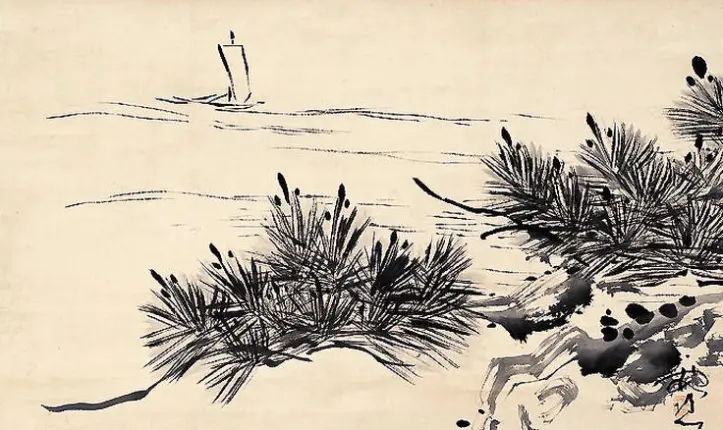
Japan Art and the Cultural Impact of Kyoto
Lee Jay Walker
Modern Tokyo Times
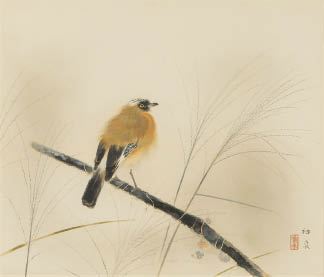
The delightful art piece above is by Tokuoka Shinsen (1896-1972). Despite the longevity of the Showa Period, his artistic soul was shaped by the Meiji (1868-1912) and Taisho periods of Japanese history (1912-1926). Of course, he naturally responded to the changing artistic ands social environments that were extremely dramatic throughout his lifetime.
Above he depicts a stunning bird in the stillness of autumn. Despite the simplicity of the subject the rich currents of culture can be felt in this art piece. It highlights the artistic and cultural gifts that he was blessed with.
The Hiroshima Museum of Art says, “A Japanese-style painter in Kyoto circle, and active as one of the representative pupils of Seiho Takeuchi during and after World War II. After creating the originally realistic style affected by the western-realism, he opened a new style in Japan, driving the simplification and decorativeness rooted in Japanese classicism.”
Watanabe Shikō (1683–1755) revealed a rare artistic sensitivity from an early age, his vision shaped within the refined currents of the Edo period — an era where culture, spirituality, and the fleeting beauty of the everyday intertwined. Whether influenced by sacred traditions or the vibrant pulse of the ukiyo-e print world, his work carries a quiet resonance that lingers.
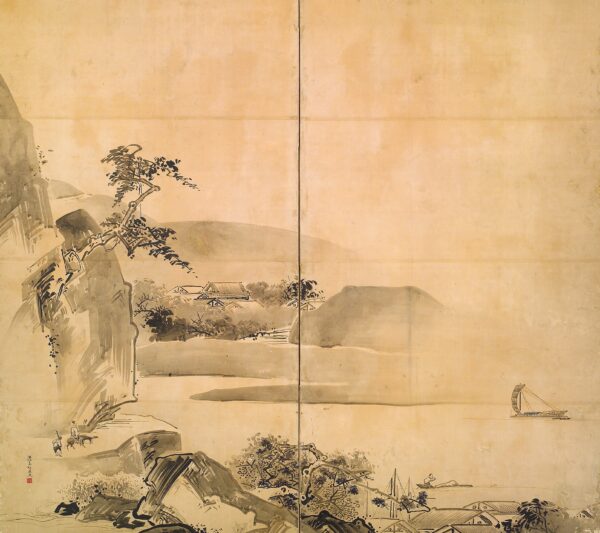
One can almost trace his footsteps from his native Kyoto to the storied landscapes of Mount Kōya, Nara, and Negoro-ji — places where the air itself seems steeped in memory and devotion. These settings likely seeped into his compositions, lending them a contemplative stillness and a sense of unseen presence.
The MET Museum comments about this art piece: “A narrow body of water is surrounded by land on three sides, with the fourth opening to allow a slender sailboat to come into view. Contrasting ink tones, from coal black to pearl gray, are united by the watery gray wash.”
The early life of Ike no Taiga (1723-1776) shatters the myths of stratification and backwardness. On the contrary, he belonged to a world where Buddhism, Confucianism, Shintoism, and high culture where in the ascendency – and where gifted individuals from poor backgrounds blessed various Japanese artistic art forms.
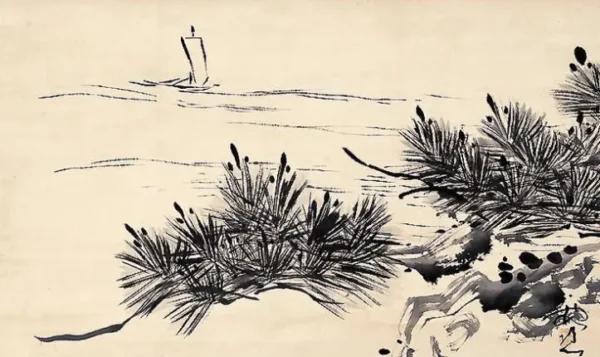
Kyoto enabled Taiga to grow and develop. Hence, the religions and philosophies of Buddhism, Confucianism, Shintoism, and Taoism ticked powerfully in his world – unlike the humdrum nature of secularism in modern Japan which is shallow in comparison. Taiga breathed the world of art, calligraphy, the spiritual dimensions of gardens, literature, poetry, and other areas of Japanese high culture that borrowed heavily from the classical world of China (the Middle Kingdom).
The Kyoto National Museum says: “Eighteenth century Kyoto produced some of the most distinctive and original painters in Japanese history, including big names such as Maruyama Ōkyo (1733–1795) and Itō Jakuchū (1716–1800). But even amongst this star-filled lineup, the artist Ike no Taiga (1723–1776), stands with fellow painter Yosa Buson (1716–1783) as the leader of the Chinese-influenced literati style of painting known as Nanga (“Southern painting”). Taiga’s works are done in a brisk, unfettered style said to exemplify the artist’s generous, humble character and indifference to fame and fortune.”
https://moderntokyonews.com/?s=Art Past ART articles via MODERN TOKYO NEWS (Modern Tokyo Times group)
MODERN TOKYO TIMES – MODERN TOKYO NEWS – please check https://moderntokyonews.com
Please check Modern Tokyo News at https://moderntokyonews.com for articles going back over 12 years. Sadly, Modern Tokyo Times got hacked and lost 14 years of articles…

Modern Tokyo News is part of the Modern Tokyo Times group
http://moderntokyotimes.com Modern Tokyo Times – International News and Japan News
http://sawakoart.com – Sawako Utsumi and Modern Tokyo Times artist
https://moderntokyonews.com Modern Tokyo News – Tokyo News and International News
PLEASE JOIN ON FACEBOOK
https://www.facebook.com/moderntokyotimes