Edo to Contemporary Japanese Art
Lee Jay Walker
Modern Tokyo Times
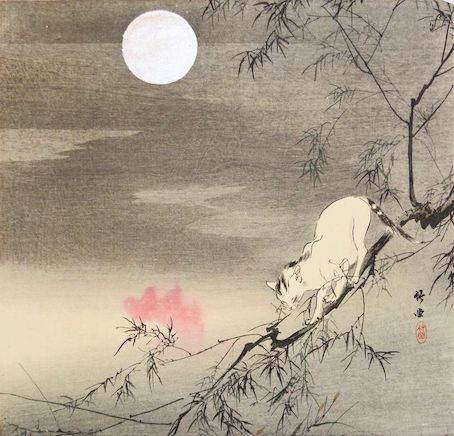
The artist Kishi Chikudo (1826–1897) embarked upon his artistic journey within the disciplined world of the Kano school, where centuries of tradition, rigorous technique, and reverence for lineage shaped the foundations of his creative spirit. Immersed in this classical environment, he absorbed the precision and compositional balance that defined one of Japan’s most influential artistic traditions. Yet Chikudo was not destined to remain confined within inherited boundaries. As his artistic horizons broadened, he found himself increasingly drawn to the poetic sensibilities of the Kishi school, whose affinity for nature and expressive freedom resonated deeply with his evolving vision.
Under the guidance of the respected Nakajima Antai, Chikudo first learned the demanding disciplines of brushwork and artistic refinement. Later, his relocation to Kyoto brought him into the orbit of Kano Eigaku, where he further polished his craft during a period when the Kano tradition still enjoyed relative stability and prestige. Ironically, it was this very grounding in discipline and continuity that enabled him to transcend convention. Rather than rejecting tradition, Chikudo transformed it, weaving together the structural elegance of the Kano school with the lyrical spirit of the Kishi aesthetic. Through this synthesis, he cultivated an artistic voice that was at once rooted in the past and illuminated by a profoundly personal vision.
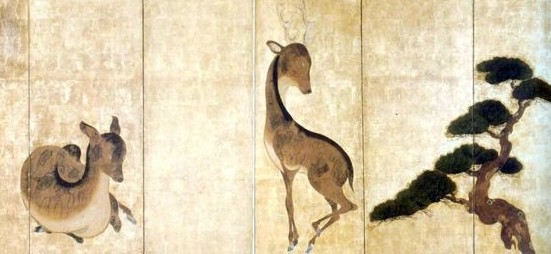
The artist Watanabe Shikō (1683–1755) entered the world seemingly blessed with an innate artistic sensitivity, one that would flourish amid the rich cultural landscape of the Edo Period. Living during an age of remarkable artistic vitality, he absorbed influences from courtly refinement, religious devotion, and the evolving visual culture that would eventually find expression in the celebrated world of ukiyo-e. These diverse currents flowed together within Shikō’s imagination, nurturing an artistic identity distinguished by both elegance and spiritual depth.
Born in the ancient imperial city of Kyoto, Shikō was surrounded by a landscape where history, faith, and beauty existed in harmonious dialogue. The sacred heights of Kōyasan, the venerable temples and cultural treasures of Nara, the storied precincts of Negoro-ji, and countless other sanctuaries enriched his artistic consciousness. Each pilgrimage site, temple garden, and mountain vista offered moments of contemplation that deepened his appreciation for the spiritual dimensions of art. Together with the refined atmosphere of Kyoto itself, these experiences formed the wellspring of inspiration from which Shikō fashioned his distinctive artistic world—a world imbued with serenity, grace, and a luminous sense of wonder.
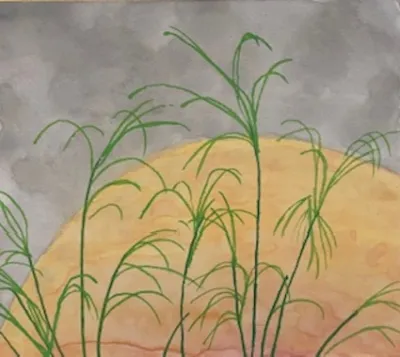
The contemporary Japanese artist Sawako Utsumi presents a captivating work entitled The Horizon and Peace of Mind, a poetic meditation on the relationship between nature, memory, and the inner landscape of the human spirit. In this evocative composition, the boundaries between distance and nearness, reality and recollection, gently dissolve. The viewer is drawn into a realm of hushed contemplation where silence possesses its own eloquence and the natural world seems suspended in a moment of timeless stillness. Through sweeping tonal transitions and delicate atmospheric nuances, Utsumi captures those rare and fleeting moments when the horizon appears infinite, inviting reflection and restoring a sense of inner calm.
Utsumi’s work pays homage to the enduring elegance of Kamisaka Sekka (1866–1942), whose decorative brilliance and sensitivity to nature remain deeply influential within Japanese art. Yet her tribute is not one of imitation. Instead, she introduces subtle shifts in color, mood, and spatial perception that breathe contemporary vitality into Sekka’s classical sensibilities. Through these quiet innovations, the horizon becomes more than a visual motif—it is transformed into a sanctuary, a place where the weary mind may wander freely and rediscover harmony beneath the vast embrace of nature.
For Utsumi, the horizon and the delicate flora that inhabit its margins are never fixed realities. Rather, they exist as fluid and illusionary frontiers, shaped as much by perception as by pigment. Her nuanced departures from tradition suggest a profound truth: even when standing before the same landscape, no two individuals experience it in precisely the same way. Memory, emotion, and personal reflection alter every encounter with beauty. Thus, The Horizon and Peace of Mind becomes more than an artistic composition; it evolves into a meditation on individuality itself, exploring the ever-changing dialogue between the external world and the landscapes that reside within the human heart.
https://fineartamerica.com/featured/the-horizon-and-peace-of-mind-sawako-utsumi.html – The Horizon and Peace of Mind
MODERN TOKYO TIMES – MODERN TOKYO NEWS – please check https://moderntokyonews.com
Please check Modern Tokyo News at https://moderntokyonews.com for articles going back over 10 years. Sadly, Modern Tokyo Times got hacked and lost 14 years of articles…

Modern Tokyo News is part of the Modern Tokyo Times group
http://moderntokyotimes.com Modern Tokyo Times – International News and Japan News
http://sawakoart.com – Sawako Utsumi’s website and Modern Tokyo Times artist
https://moderntokyonews.com Modern Tokyo News – Tokyo News and International News
PLEASE JOIN ON TWITTER
https://twitter.com/MTT_News Modern Tokyo Times
PLEASE JOIN ON FACEBOOK