
Contemporary Japanese Art by Sawako Utsumi
Lee Jay Walker
Modern Tokyo Times
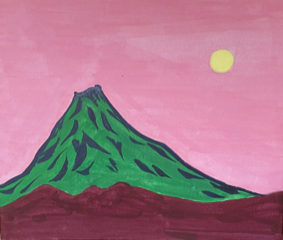
Sawako Utsumi is a contemporary artist from northern Japan whose paintings transform familiar landscapes into luminous realms of imagination. Through bold, expressive colors and poetic compositions, she reinterprets mountains and skies as emotional landscapes rather than literal places. Although spiritual symbolism is never imposed, the quiet influence of Buddhism and Shinto gently permeates her art through timeless themes of continuity, impermanence, harmony, and the enduring dialogue between humanity and nature.
In the artwork above, Utsumi offers a heartfelt homage to Hagiwara Hideo (1913–2007). While acknowledging the profound legacy of this celebrated artist, she simultaneously establishes her own distinctive artistic voice. Her vibrant palette reshapes the landscape into something both familiar and dreamlike, where nature becomes an inner vision. The glowing yellow moon suspended above the emerald mountain, together with the rich crimson earth, radiates warmth, renewal, and quiet vitality. Rather than simply echoing Hagiwara’s vision, Utsumi transforms it into a deeply personal meditation on memory, imagination, and the timeless beauty of the natural world.
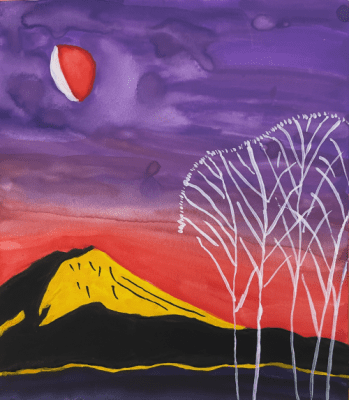
Hagiwara rose to prominence during the latter half of the twentieth century, his artistic sensibilities profoundly shaped by the hardships, uncertainty, and emotional scars left by the wartime era. Yet, like many great Japanese artists, he discovered enduring beauty amid suffering, allowing resilience and hope to emerge through simplicity and grace.
The revered poet, potter, and Buddhist nun Ōtagaki Rengetsu (1791–1875) likewise transformed personal sorrow into enduring beauty. Her Buddhist faith sustained her through extraordinary loss, and her poetry continues to illuminate the quiet strength found in compassion, acceptance, and spiritual reflection.
She wrote:
My wish is to see
a cloudless moon
above the lotus flower
in my next life.
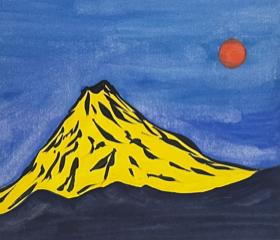
One can almost sense Rengetsu’s gentle spirit drifting through Sawako Utsumi’s mountain landscapes, where radiant horizons and tranquil skies seem suspended between memory and eternity. Her paintings invite contemplation rather than explanation, encouraging the viewer to pause and experience the silent poetry that lies beyond the visible world.
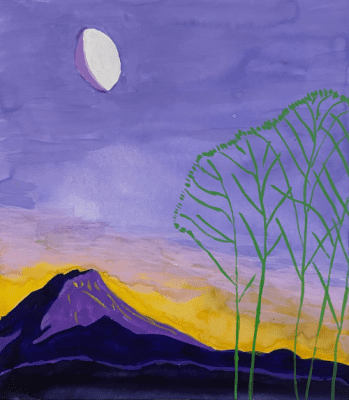
Together, the four artworks possess an ethereal serenity. Their dreamlike simplicity lingers in the heart, revealing new emotional depths with each viewing and quietly reminding us that the landscape of the spirit can be as vast and luminous as the mountains themselves.
https://moderntokyonews.com/?s=Art Past articles about ART via MODERN TOKYO NEWS (Modern Tokyo Times group)
MODERN TOKYO TIMES – MODERN TOKYO NEWS – please check https://moderntokyonews.com
Please check Modern Tokyo News at https://moderntokyonews.com for articles going back over 12 years. Sadly, Modern Tokyo Times got hacked and lost 14 years of articles…
https://fineartamerica.com/featured/japanese-yellow-mountain-and-stillness-sawako-utsumi.html Japanese Yellow Mountain and Stillness
https://fineartamerica.com/featured/stillness-of-the-dimming-night-homage-to-hagiwara-hideo-sawako-utsumi.htmlStillness of the Dimming Night by Sawako Utsumi
https://fineartamerica.com/featured/japanese-green-mountain-and-tranquility-sawako-utsumi.html Japanese Green Mountain and Tranquility
https://fineartamerica.com/featured/stillness-of-the-night-utsumi-and-homage-to-hagiwara-hideo-sawako-utsumi.html?newartwork=trueStillness of the Night by Sawako Utsumi
http://sawakoart.com – Sawako Utsumi

Modern Tokyo News is part of the Modern Tokyo Times group
http://moderntokyotimes.com Modern Tokyo Times – International News and Japan News
http://sawakoart.com – Sawako Utsumi and Modern Tokyo Times artist
https://moderntokyonews.com Modern Tokyo News – Tokyo News and International News
PLEASE JOIN ON TWITTER
https://twitter.com/MTT_News Modern Tokyo Times
PLEASE JOIN ON FACEBOOK
https://www.facebook.com/moderntokyotimes