
Japan Art and Reimagining L. S. Lowry Through Northern Japanese Eyes
Lee Jay Walker
Modern Tokyo Times
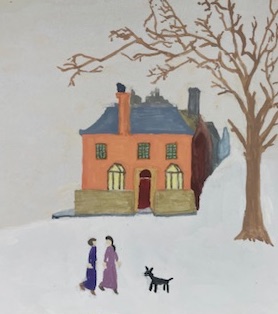
Sawako Utsumi is a contemporary artist from northern Japan whose work frequently enters into a fascinating artistic conversation with Britain. Several of her works reveal a particular admiration for the enigmatic northern English artist L. S. Lowry, whose paintings became deeply associated with the everyday lives of working-class communities, industrial landscapes, factories, streets, houses, and the quiet rhythms of ordinary existence. Yet Utsumi does not simply imitate Lowry. Instead, she takes elements of his visual language and transforms them through her own distinctive artistic sensibility, particularly through a different relationship with colour, atmosphere, nature, and human warmth.
Lowry’s world was unmistakably northern English. His small figures moving through industrial landscapes became part of a remarkable visual record of ordinary people living amid factories, terraces, chimneys, streets, churches, and the changing fortunes of industrial society. There was often a sense of anonymity and distance within these compositions. Yet Utsumi approaches this world from another northern landscape, bringing her own cultural imagination to themes of community, nature, seasonal change, hardship, and everyday existence.
In this work inspired by Lowry, Utsumi transforms the landscape through a much warmer colour spectrum. A distinctive house emerges from the snow beneath a bare winter tree, while two figures and a dog appear to share a quiet moment together. The scene possesses an intimate and almost dreamlike quality. Rather than allowing the snow to become synonymous with isolation or severity, Utsumi turns it into a poetic setting for companionship and contentment. The house itself becomes an important presence — warm, colourful, and almost protective within the surrounding winter landscape.
Her second Lowry-inspired composition reveals this transformation in another way. The industrial character remains: factories, chimneys, broad streets, houses, and small figures occupy the landscape. Yet Utsumi introduces striking reds, greens, blues, oranges, and soft pinks. The familiar industrial environment therefore remains recognisable, but its emotional temperature changes dramatically. What could easily become a representation of bleakness is instead filled with colour and life.
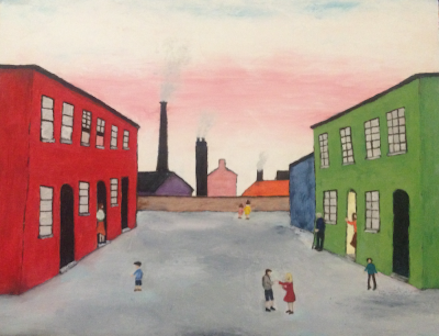
This transformation is central to Utsumi’s artistic dialogue with Lowry. She takes imagery historically associated with industrial Britain and working-class existence and places it within a visual language of hope, strength, and joy. Her figures may remain small in relation to the surrounding architecture, but they are not diminished by it. Instead, they become part of a living community in which ordinary encounters, companionship, children playing, animals, family life, and simple moments of happiness possess their own dignity.
In earlier works inspired by Lowry, Utsumi similarly evokes optimism. Rather than focusing exclusively on economic hardship, industrial decline, or social alienation, she searches for the human warmth that survives within difficult environments. Her art consequently becomes less a representation of adversity itself and more an exploration of how people continue to find meaning, companionship, affection, and hope despite challenging circumstances.
There is also something particularly fascinating about the cultural exchange taking place. Lowry’s artistic vision emerged from northern England, with its industrial heritage and working communities. Utsumi approaches these themes from northern Japan, a region where nature, seasonal change, community, and the rhythms of ordinary existence have their own profound cultural resonance. Thus, when snow, bare trees, modest houses, people, and animals appear in her Lowry-inspired works, they can be viewed through another cultural lens. The landscape becomes more than a geographical setting; it becomes a space for contemplating the relationship between humanity, nature, and everyday life.
This is why Utsumi’s interpretation should not be regarded merely as an imitation of Lowry. She enters into a conversation with him. Lowry provides the artistic and cultural starting point, but Utsumi changes the emotional vocabulary. She retains the industrial streets, the modest architecture, and the small human figures, while introducing a greater sense of warmth and optimism. In doing so, she refuses to allow working-class life to be understood solely through the familiar stereotypes of poverty, bleakness, alienation, or hardship.
Her vision instead celebrates resilience. The people within these landscapes continue to live, meet, walk, play, work, care for one another, and experience moments of happiness. Their strength is not necessarily dramatic or heroic. It is found within the ordinary — in companionship beneath a winter sky, children meeting in a street, a dog accompanying its owners, or people simply continuing with their daily lives. Utsumi discovers beauty precisely because life continues despite adversity.
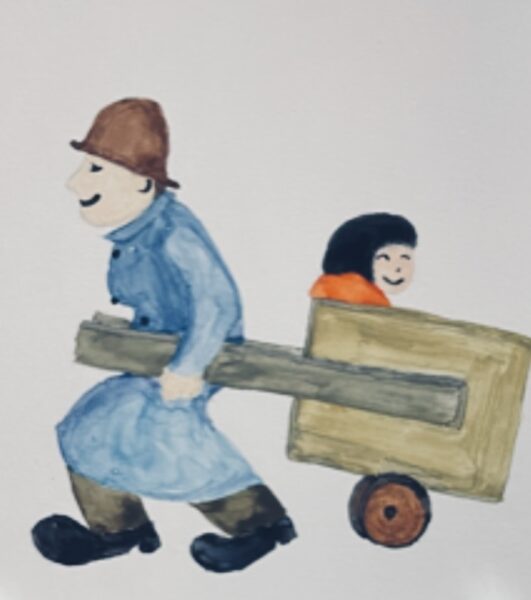
Her work consequently demonstrates how art can travel between cultures without losing its original identity. Lowry’s northern England becomes a starting point, but Utsumi’s imagination carries the conversation into another cultural and emotional landscape. Her Japanese perspective does not erase the social realities that underpin Lowry’s art. Rather, it encourages the viewer to look beyond the stereotype of industrial hardship and recognise the humanity existing within it.
In this sense, Utsumi creates a subtle cultural bridge between northern England and northern Japan. Both regions possess histories shaped by demanding environments, changing communities, seasonal realities, and the endurance required by ordinary people. Yet Utsumi’s artistic response emphasises what survives alongside adversity: colour, companionship, affection, dignity, resilience, and hope.
Ultimately, Sawako Utsumi interprets the beauty of Lowry through a distinctly personal and northern Japanese lens. Her art reminds us that hardship does not possess a monopoly on meaning, just as industrial landscapes do not have to be painted only in shades of despair. Through colour and imagination, she discovers warmth within winter, humanity within industrial streets, and joy within ordinary existence.
In Utsumi’s interpretation of Lowry, that conversation extends from northern England to northern Japan, revealing something universal: ordinary people living ordinary lives can possess an extraordinary capacity for endurance, warmth, quiet dignity, and joy.
https://fineartamerica.com/featured/joy-in-the-snow-sawako-utsumi.html – Joy in the Snow
https://fineartamerica.com/featured/hearts-of-joy-sawako-utsumi.html?newartwork=true – Hearts of Joy
https://fineartamerica.com/featured/traditional-joy-in-north-england-sawako-utsumi.html – Traditional Joy in North England
https://moderntokyonews.com/?s=Art Past ART articles via MODERN TOKYO NEWS (Modern Tokyo Times group)
MODERN TOKYO TIMES – MODERN TOKYO NEWS – please check https://moderntokyonews.com
Please check Modern Tokyo News at https://moderntokyonews.com for articles going back over 12 years. Sadly, Modern Tokyo Times got hacked and lost 14 years of articles…

Modern Tokyo News is part of the Modern Tokyo Times group
http://moderntokyotimes.com Modern Tokyo Times – International News and Japan News
http://sawakoart.com – Sawako Utsumi’s website and Modern Tokyo Times artist
https://moderntokyonews.com Modern Tokyo News – Tokyo News and International News
PLEASE JOIN ON FACEBOOK
https://www.facebook.com/moderntokyotimes