
Japanese Art: Buddhism to Nature by Kawabata Gyokusho
Lee Jay Walker
Modern Tokyo Times
Kawabata Gyokusho (1842–1913) was born during the late Edo Period, yet his artistic identity blossomed amid the sweeping cultural, political, and social transformations of the Meiji Period (1868–1912). Passing away in the early Taisho Period, Gyokusho belonged to a generation that witnessed Japan move from the traditions of the shogunate toward a modernizing nation, while the enduring language of Japanese art continued to evolve.
At only eleven years of age, during the early 1850s, Gyokusho began studying under Nakajima Raisho. His artistic education introduced him to the rich traditions of the Shijō and Maruyama schools, alongside Western-style art. This combination of influences would become increasingly significant during an era when Japanese artists were navigating the relationship between inherited cultural aesthetics and new artistic approaches from abroad.
Bonhams notes, “Apprenticed at age 11 to the Maruyama-school painter Nakajima Raisho,” Gyokusho later moved from Kyoto to Edo (Tokyo) in 1866, establishing himself as an independent artist. Following the Meiji Restoration of 1867–1868, he submitted works to official exhibitions, and in 1878 founded his own painting school, the Tenshindo. His journey reflects the changing artistic landscape of Japan, where traditional knowledge and institutional transformation increasingly encountered one another.
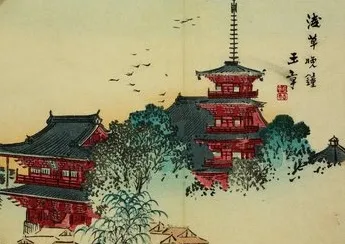
The second artwork presents a magnificent Buddhist compound, where the pagoda and monks evoke a spiritual landscape shaped by centuries of devotion. Within such a setting, architecture becomes more than an arrangement of timber, stone, and graceful proportions. It serves as a bridge between the earthly and the sacred, inviting the faithful to contemplate impermanence, continuity, and the quiet presence of Buddhist teachings. The pagoda rises as a symbol of spiritual aspiration, while the monks connect the living present with a religious heritage extending across generations.
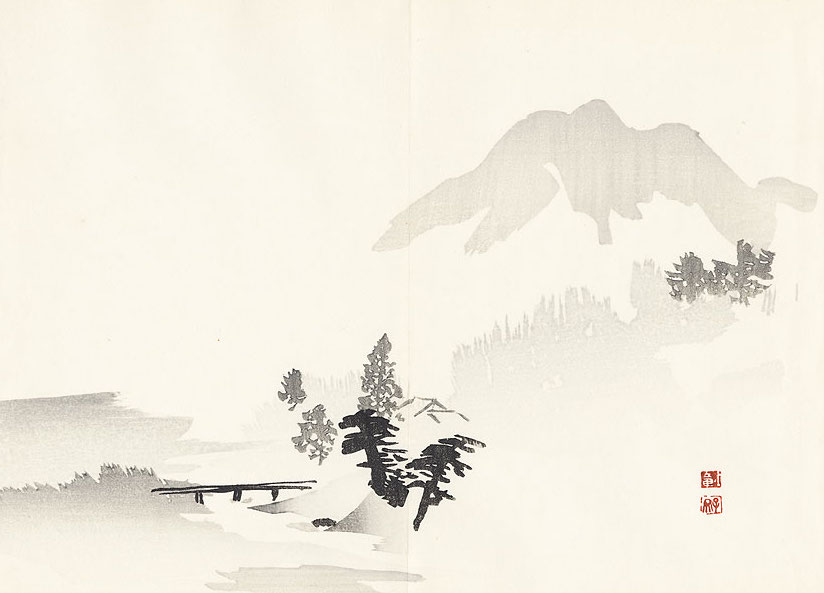
In the works left to us by Gyokusho, simplicity often assumes a commanding presence. His compositions are restrained, uncluttered, and tranquil, yet their apparent sparseness reveals profound cultural depth. Space is not empty; it breathes. A carefully placed structure, a distant landscape, or a modest human presence can suggest an entire world of contemplation. Each brushstroke carries a sense of discipline, reflecting the artistic traditions of Kyoto and the broader Japanese appreciation of harmony, balance, and the spiritual dimensions of nature.
Gyokusho’s paintings do not demand attention through excess. Instead, they invite the viewer to pause. Their quietness evokes the atmosphere of a temple garden, the stillness of mountain scenery, or the gentle passage of seasons across an ancient Buddhist landscape. Within this artistic restraint lies an understanding that beauty need not be overwhelming to be profound. Sometimes, the smallest details become the most enduring.
Ultimately, Kawabata Gyokusho stood at an important cultural crossroads. He encountered Western artistic influences while remaining connected to the traditions that shaped Japanese painting. Yet his significance extends beyond the simple contrast between East and West. His life illustrates how artistic heritage can adapt without losing its essential character, and how cultural continuity may be preserved through the practice of renewal.
Gyokusho was both a student of inherited traditions and a steward of their future. Through his art and teaching, he participated in the continuing conversation between Japan’s historical identity and the changing world around it. Centuries change. Artistic styles change. Yet the conversation between humanity, nature, beauty, and the sacred continues.
https://moderntokyonews.com/?s=Art Past ART articles via MODERN TOKYO NEWS (Modern Tokyo Times group)
MODERN TOKYO TIMES – MODERN TOKYO NEWS – please check https://moderntokyonews.com
Please check Modern Tokyo News at https://moderntokyonews.com for articles going back over 12 years. Sadly, Modern Tokyo Times got hacked and lost 14 years of articles…

Modern Tokyo News is part of the Modern Tokyo Times group
http://moderntokyotimes.com Modern Tokyo Times – International News and Japan News
http://sawakoart.com – Sawako Utsumi’s website and Modern Tokyo Times artist
https://moderntokyonews.com Modern Tokyo News – Tokyo News and International News
PLEASE JOIN ON FACEBOOK
https://www.facebook.com/moderntokyotimes