Japan Art and Isaac Newton (Rainbow and Rays)
Lee Jay Walker
Modern Tokyo Times
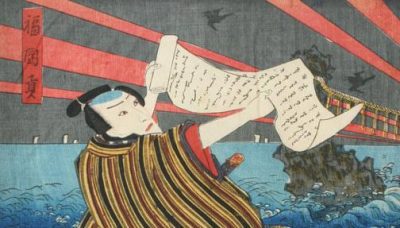
Ukiyo-e prints in this article shimmer with rainbows and falling shafts of sun — light caught, divided, and reborn upon paper. In their quiet brilliance, one senses the invisible laws that captivated Isaac Newton, a mind that wandered freely across alchemy, astronomy, mathematics, and physics, leaving behind a constellation of insight.
Newton once wrote, “Plato is my friend, Aristotle is my friend, but my greatest friend is truth.” It is a sentiment that feels at home among these prints, where beauty and inquiry meet—where color is not merely seen, but understood.
Reflecting on this legacy, Albert Einstein observed: “No one must think that Newton’s great creation can be overthrown in any real sense by this [Theory of Relativity] or by any other theory. His clear and wide ideas will forever retain their significance as the foundation on which our modern conceptions of physics have been built.”
The first print by Utagawa Kunisada (1786–1865) feels like a mirage — its kabuki origins dissolving into something more elusive. Through the prism of imagination, time bends; space softens. It becomes akin to a scientist’s notebook from another age, where observation flows into revelation, and the eye — like Newton’s—learns to see beneath the surface.
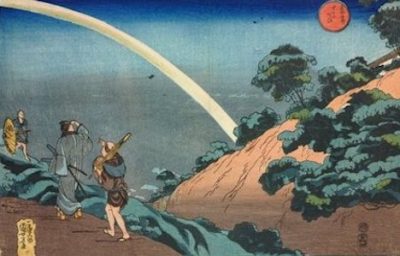
Newton himself asked: “Do not the Rays of Light which fall upon Bodies, and are reflected or refracted, begin to bend before they arrive at the Bodies; and are they not reflected, refracted, and inflected, by one and the same Principle, acting variously in various Circumstances?”
In the second print by Utagawa Kuniyoshi (1798–1861), one can almost imagine a youthful Newton standing at the edge of nature’s theater — watching light fracture through sky and water, quietly shaping the ideas that would later illuminate the world.
As noted by the Smithsonian Institution: “By scientifically establishing our visible spectrum (the colors we see in a rainbow), Newton laid the path for others to experiment with color in a scientific manner. His work led to breakthroughs in optics, physics, chemistry, perception, and the study of color in nature.”
Thus, Newton’s intellect continues to refract through time — much like light through a prism — echoing alongside figures such as Galileo Galilei, Nicolaus Copernicus, and Einstein himself. In both art and science, the same quiet miracle persists: the transformation of light into understanding, and of observation into wonder.

Modern Tokyo News is part of the Modern Tokyo Times group
http://moderntokyotimes.com Modern Tokyo Times – International News and Japan News
http://sawakoart.com – Sawako Utsumi and her website – Modern Tokyo Times artist
https://moderntokyonews.com Modern Tokyo News – Tokyo News and International News
PLEASE JOIN ON TWITTER
https://twitter.com/MTT_News Modern Tokyo Times
PLEASE JOIN ON FACEBOOK