
Japanese Art and Poetry: Jizō and the Spiritual Landscape of Impermanence (Buddhism)
Lee Jay Walker
Modern Tokyo Times
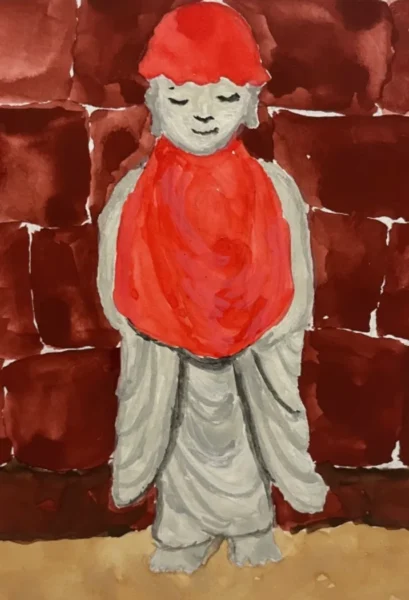
Sawako Utsumi frequently explores religious themes in her artwork, drawing inspiration from Buddhism, Christianity, and Shintoism. Yet Buddhist imagery often occupies a particularly important place in her creative expression, allowing her to reflect upon compassion, mortality, spiritual protection, and the delicate relationship between human beings and the unseen world.
In Japan, few Buddhist figures possess a more tender and enduring presence than Jizō (Ojizō-sama). Found beside rural roads, temple grounds, village paths, cemeteries, and mountain routes, Jizō is both a deeply religious figure and an intimate part of Japanese cultural life. His stone image can appear humble and weathered, yet his spiritual significance is immense.
Jizō is a bodhisattva of compassion and protection, traditionally associated with those who suffer, travelers, children, and the dead. In Japanese Buddhism, his compassionate vow extends into the difficult spaces between life and death, offering reassurance to those who feel abandoned, vulnerable, or lost.
The Metropolitan Museum of Art beautifully captures this spiritual role, stating: “Jizō’s compassionate presence illuminates the righteous way from hell to paradise, and he saves from harm those who call out to him.”
This idea of compassion reaching beyond the visible world is central to the enduring cultural presence of Jizō in Japan. Small statues may be dressed with red bibs, hats, or other offerings, transforming an ancient Buddhist image into something deeply personal. Parents, families, pilgrims, and ordinary people have long approached Jizō with prayers for protection, remembrance, and peace.
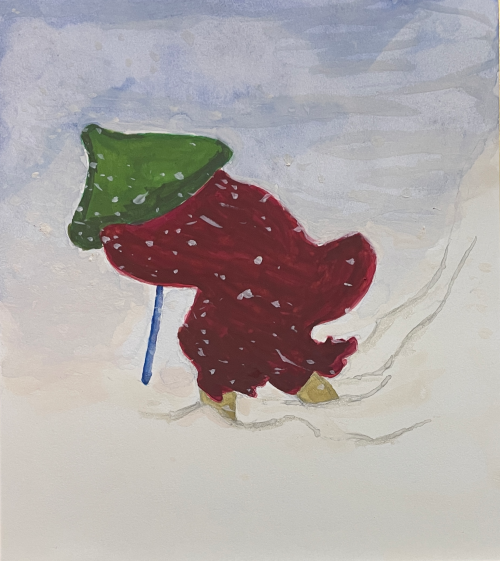
Utsumi’s depiction therefore becomes more than an image of a Buddhist figure. Her Jizō appears almost suspended between the earthly and spiritual realms—quietly present before the viewer while symbolizing something that cannot be contained by the physical world.
The religious atmosphere surrounding Jizō also resonates profoundly with the Japanese understanding of mujō, the Buddhist awareness of impermanence. Nothing remains unchanged. Seasons pass, flowers wither, leaves fall, human beings grow old, and eventually life itself comes to an end. Yet compassion, memory, prayer, and spiritual faith can provide continuity amid this constant transformation.
The celebrated monk and poet Henjō (816–890) beautifully expressed this melancholy awareness:
On his way to leave the world, a man
Comes to rest
Beneath the trees
But he finds no shade
For every Autumn leaf has fallen.
These words are deeply poignant. The traveler is approaching the end of his journey, seeking something as simple as shade beneath a tree, only to discover that even the leaves that once offered protection have disappeared. Nature itself becomes a Buddhist meditation on impermanence.
Yet there is also a profound religious quality to Henjō’s words. The absence of shade does not merely describe autumn; it reminds us that worldly existence cannot provide permanent shelter. The human journey ultimately leads beyond the things of this transient world. In this sense, the spiritual symbolism of Jizō becomes particularly powerful: when worldly protection disappears, compassion remains as an enduring ideal.
Uejima Onitsura (1661–1738), born in Hyogo and later becoming famous in Osaka, similarly captured the loneliness of the human condition:
Useless dreams, alas!
Over desolate fields
winds whisper as they pass.
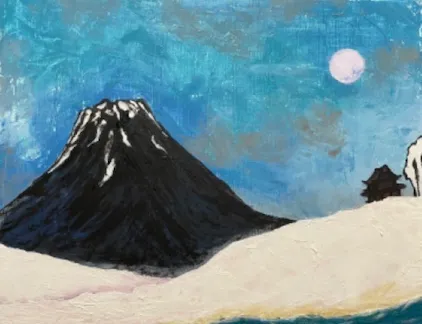
The desolate landscape becomes almost a spiritual landscape. Dreams disappear, the fields remain empty, and only the wind continues its ancient journey. There is a distinctly Buddhist sensibility here—the recognition that worldly desires and attachments are fleeting, while nature continues beyond the individual human existence.
Likewise, Matsuo Bashō (1644–1694) wrote with extraordinary simplicity:
Falling ill on a journey
my dreams go wandering
over withered fields
Bashō’s words carry the feeling of a pilgrim confronting mortality. The journey is both physical and spiritual, while the withered fields evoke the impermanence that lies at the heart of Buddhist thought. The wandering dream becomes a metaphor for a human life that is beautiful precisely because it is temporary.
This connection between religion, nature, poetry, and impermanence is fundamental to Japanese cultural expression. Buddhism did not exist in isolation from Japanese life; it became intertwined with Shinto traditions, seasonal customs, poetry, painting, pilgrimage, architecture, and the rhythms of the natural world. Consequently, a simple Jizō statue beside a road can carry centuries of religious and cultural meaning.
Utsumi’s artwork captures something of this quiet spirituality. Her Jizō is not presented as an overwhelming supernatural presence. Instead, the figure appears gentle, almost contemplative, standing before the viewer with closed eyes and a peaceful expression. The simplicity reinforces the deeper message: compassion does not always arrive with spectacle. Sometimes it is found in silence.
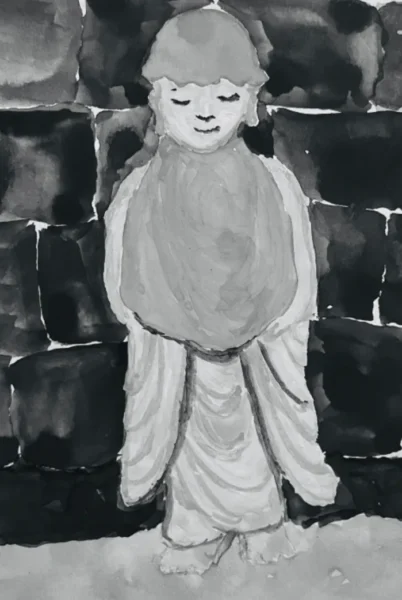
The second work similarly evokes a world of winter, pilgrimage, solitude, and spiritual endurance. The small figure moving through an expansive landscape recalls the wandering monks and poets of earlier centuries, whose journeys were physical voyages but also acts of religious contemplation. The red and green tones provide a subtle reminder that even within winter and desolation, life and spiritual hope remain.
Thus, the religious world surrounding Jizō is also a cultural world—one in which Buddhist teachings, Shinto sensibilities, poetry, seasonal change, pilgrimage, and artistic expression have continually crossed paths.
Ultimately, Utsumi portrays the spiritual presence of Jizō as something only partially revealed in this world. His physical form may be humble, yet his meaning reaches toward questions that have occupied Japanese religious and cultural thought for centuries: Where do we go when life ends? What protects us when worldly protection disappears? Can compassion transcend death? And how should we live when we know that everything is impermanent?
Jizō offers no loud answer. Instead, he remains quietly beside the road.
The seasons change.
The autumn leaves fall.
The fields become withered.
The traveler grows tired.
And still, Ojizō-sama remains—an enduring symbol of compassion, protection, remembrance, and the possibility of spiritual peace beyond the fleeting nature of human existence.
https://moderntokyonews.com/category/japan-culture/ Past JAPAN CULTURE articles via MODERN TOKYO NEWS
MODERN TOKYO TIMES – MODERN TOKYO NEWS – please check https://moderntokyonews.com
Please check Modern Tokyo News at https://moderntokyonews.com for articles going back over 12 years. Sadly, Modern Tokyo Times got hacked and lost 14 years of articles…
https://fineartamerica.com/featured/jizo-and-the-buddhist-half-open-door-sawako-utsumi.html?newartwork=true Jizo and the Buddhist Half-Open Door
https://fineartamerica.com/featured/bleak-midwinter-and-the-buddhist-tree-of-life-sawako-utsumi.html Bleak Midwinter and the Buddhist Tree of Life
https://fineartamerica.com/featured/japanese-buddhist-holy-men-in-the-deep-winter-sawako-utsumi.html Buddhist Holy Men in Deep Winter
https://fineartamerica.com/featured/jizo-and-the-buddhist-lantern-of-life-sawako-utsumi.html Jizo and the Buddhist Lantern of Life
https://fineartamerica.com/featured/the-desolate-japanese-buddhist-path-sawako-utsumi.html The Desolate Buddhist Path

Modern Tokyo News is part of the Modern Tokyo Times group
http://moderntokyotimes.com Modern Tokyo Times – International News and Japan News
http://sawakoart.com – Sawako Utsumi and her website – Modern Tokyo Times artist
https://moderntokyonews.com Modern Tokyo News – Tokyo News and International News
PLEASE JOIN ON FACEBOOK
http://facebook.com/moderntokyotimes