
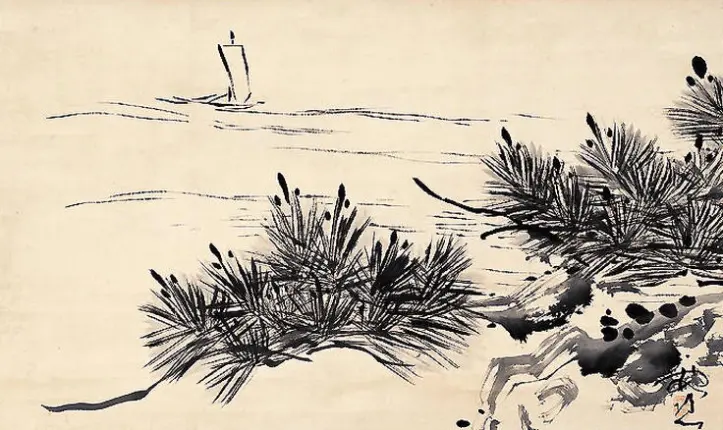
Kyoto and Japanese Art
Lee Jay Walker
Modern Tokyo Times
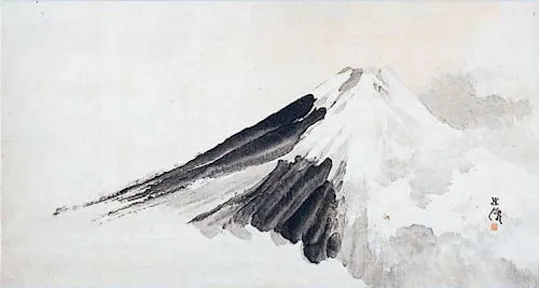
Kubota Beisen was born into the refined cultural tapestry of Kyoto, a city where changing seasons, ancient temples, and enduring traditions quietly inspired every observant soul. He first trained under the distinguished Suzuki Hyakunen (1825–1891), yet his artistic path was never wholly shaped by the hands of others.
His father, an innkeeper grounded in the practical realities of everyday life, initially hesitated to support his son’s artistic ambitions. Yet Beisen’s devotion to painting — quiet, steadfast, and unwavering — ultimately prevailed.
Although he absorbed the teachings of both Suzuki Hyakunen and later Kōno Bairei (1844–1895), Beisen remained, in both spirit and practice, largely self-directed. His artistry flourished through inner conviction, guided as much by personal vision as by the formal traditions he encountered. Rather than merely inheriting established styles, he refined them into an artistic voice that was distinctly his own.
The artwork above by Kubota Beisen depicts Mount Fuji with remarkable economy of expression. Rather than overwhelming the viewer with intricate detail, Beisen relies upon bold, confident brushwork and generous expanses of untouched paper to evoke both the mountain’s physical grandeur and its spiritual presence. The sweeping ink forms convey strength and permanence, while the pristine summit appears to emerge effortlessly from drifting mist, reflecting the Japanese aesthetic that beauty often resides in suggestion rather than elaboration.
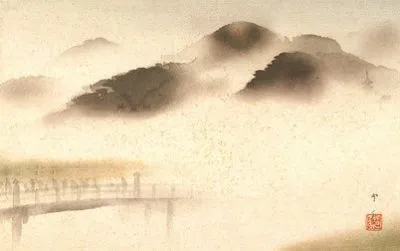
The artwork above is by Dōmoto Inshō (1891–1975), a master capable of drawing poetry from restraint. In this composition, he turns his gaze toward the tranquil mountains surrounding Kyoto, capturing their quiet majesty through a style that is at once understated and profoundly expressive.
With deliberate minimalism — each line a measured breath, each contour a whispered memory — Inshō allows the landscape to speak in its own serene language. Nothing is excessive, nothing distracts. The result is a work of remarkable elegance, where simplicity becomes a source of luminous depth and silence possesses its own eloquence.
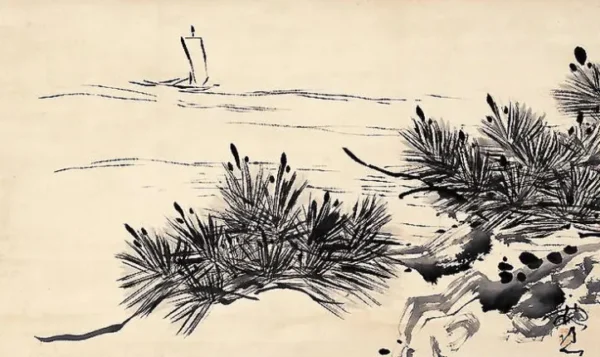
The early life of Ike no Taiga (1723–1776) gently dissolves modern misconceptions that portray the Edo period as culturally rigid or intellectually insular. Instead, he emerged from a world where Buddhism, Confucianism, Shintoism, and the wider realm of classical learning illuminated everyday life. It was an age when the brush, the sutra, the poetic verse, and the quiet elegance of scholarship were valued more highly than material display or fleeting celebrity.
By comparison, the modern glorification of transient fame — whether attached to sporting icons, entertainers, or other passing figures—appears remarkably shallow. Taiga’s world was one in which culture shaped character and artistic refinement was regarded as a worthy pursuit. Although born into poverty, the gates of learning and high culture opened before him, not through privilege, but through a society that still esteemed spiritual cultivation, literary achievement, and artistic excellence.
Kyoto was both his cradle and his catalyst. Within Japan’s ancient capital, the rhythms of Buddhism, Confucian ethics, Shinto cosmology, and Taoist contemplation formed the atmosphere in which he matured. Unlike the more secular outlook that characterizes much of contemporary Japan, Taiga inhabited a world imbued with spiritual reflection and cultural sophistication.
He lived and breathed painting, calligraphy, gardens shaped by spiritual geometry, literature, poetry, and the vast reservoir of East Asian classical learning. His brush was more than an artistic instrument — it became a bridge linking Japan to the revered traditions of China, while transforming those influences into something unmistakably Japanese: a vision enriched by native sensibilities, poetic imagination, and an enduring reverence for nature.
https://moderntokyonews.com/?s=Art Past articles about ART via MODERN TOKYO NEWS (Modern Tokyo Times group)
MODERN TOKYO TIMES – MODERN TOKYO NEWS – please check https://moderntokyonews.com
Please check Modern Tokyo News at https://moderntokyonews.com for articles going back over 12 years. Sadly, Modern Tokyo Times got hacked and lost 14 years of articles…

Modern Tokyo News is part of the Modern Tokyo Times group
http://moderntokyotimes.com Modern Tokyo Times – International News and Japan News
http://sawakoart.com – Sawako Utsumi’s website and Modern Tokyo Times artist
https://moderntokyonews.com Modern Tokyo News – Tokyo News and International News
PLEASE JOIN ON TWITTER
https://twitter.com/MTT_News Modern Tokyo Times
PLEASE JOIN ON FACEBOOK
http://facebook.com/moderntokyotimes